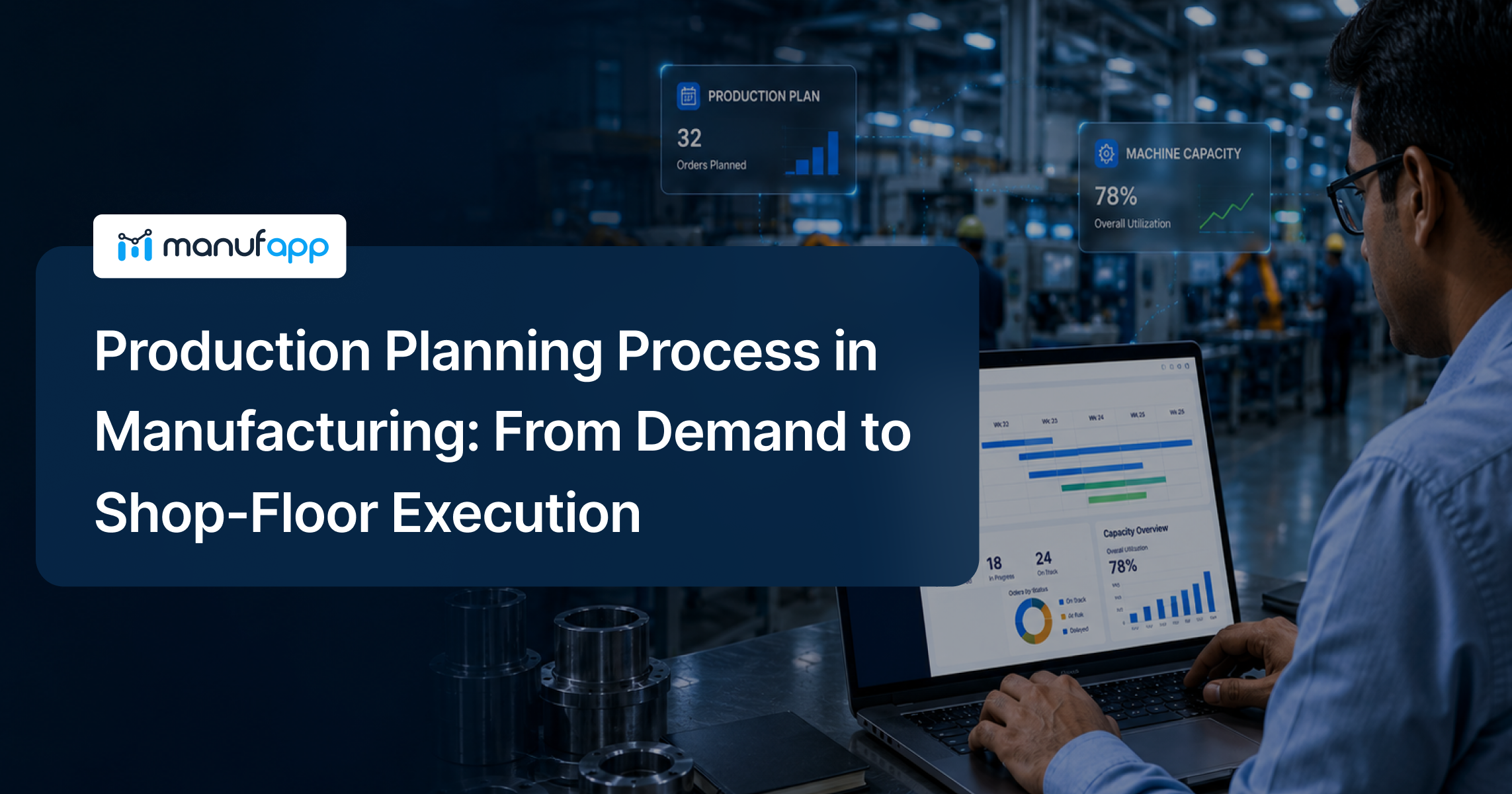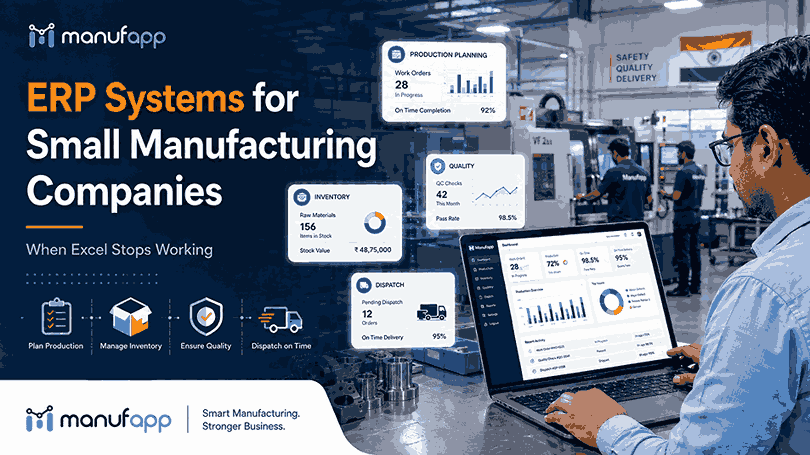


Production planning in a Manufacturing ERP helps factories schedule machines, manage materials, reduce downtime, and improve delivery timelines from a single platform. Modern Manufacturing ERP systems like ManufApp combine AI-powered planning, MES visibility, inventory control, and real-time production tracking to help manufacturers reduce delays by up to 35%
| Feature | Traditional Planning | Manufacturing ERP |
|---|---|---|
| Production Scheduling | Excel/manual | Automated & real-time |
| Inventory Visibility | Delayed updates | Live stock tracking |
| Machine Planning | Reactive | AI-assisted scheduling |
| Downtime Management | Manual reporting | Real-time alerts |
| Delivery Tracking | Difficult | End-to-end visibility |
| Quality Monitoring | Separate systems | Integrated ERP + MES |
| Decision Making | Historical reports | Live dashboards |
| Scalability | Limited | Multi-plant ready |
What Is Production Planning in Manufacturing ERP?
Production planning in Manufacturing ERP is the process of organising machines, manpower, materials, and timelines using a centralised digital system.
Instead of managing production through Excel sheets, phone calls, or disconnected software, an ERP Manufacturing platform gives you one connected environment.
A modern Manufacturing ERP Software typically handles:
- Production scheduling
- Material planning
- Work order management
- Capacity planning
- Inventory control
- Shop floor tracking
- Quality management
- Maintenance scheduling
Platforms like ManufApp combine ERP with MES functionality, helping manufacturers get real-time visibility across the shop floor.
Why Are Manufacturers Moving from Excel to ERP Manufacturing?
Most factories still struggle with:
- Frequent production delays
- Material shortages
- Unplanned downtime
- Manual planning errors
- Lack of machine visibility
- Excess inventory
- Poor coordination between departments
When planning depends on spreadsheets, information becomes outdated quickly.
According to IDC, more than 40% of manufacturers are expected to upgrade to AI-based scheduling systems by 2026.
That shift is happening because manufacturers want:
- Faster planning decisions
- Better delivery performance
- Lower WIP inventory
- Improved machine utilisation
- Real-time production visibility
An ERP for Manufacturing Industry centralises all departments so production teams, purchase teams, quality teams, and management work from the same live data.
How Does Manufacturing ERP Improve Production Planning?
1. Real-Time Production Visibility
A Manufacturing ERP provides live updates from the shop floor.
Managers can monitor:
- Running jobs
- Machine status
- Production quantity
- Rejections
- Delays
- Operator productivity
ManufApp’s MES capabilities allow manufacturers to capture production data directly from the shop floor using barcode systems and IoT integrations.
2. Better Production Scheduling
Production scheduling becomes difficult when machines break down or orders change suddenly.
AI-powered scheduling tools can automatically:
- Reassign jobs
- Adjust machine loads
- Predict bottlenecks
- Prioritise urgent orders
This helps reduce planning dependency on a single production manager.
According to manufacturing studies, predictive scheduling can reduce production delays by 20–35%.
3. Accurate Material Requirement Planning
Material shortages are one of the biggest reasons for production stoppages.
A Manufacturing ERP automatically calculates:
- Raw material requirements
- Safety stock levels
- Purchase timelines
- Consumption trends
- Vendor lead times
This prevents overstocking and understocking.
For Indian manufacturers dealing with fluctuating demand and supply chain disruptions, ERP-driven material planning has become critical.
4. Machine Capacity Planning
Capacity planning helps manufacturers avoid overload situations.
The ERP analyses:
- Machine availability
- Shift schedules
- Planned maintenance
- Operator allocation
- Production targets
This allows planners to create realistic schedules instead of aggressive timelines that fail on the shop floor.
5. Integrated Maintenance Planning
Machine breakdowns directly affect production planning.
Modern ERP Manufacturing systems integrate maintenance schedules with production schedules.
ManufApp’s Maintenance AI helps technicians diagnose machine problems faster and guides them during breakdown situations.
Predictive maintenance can reduce unplanned downtime by 30–50%.
What Features Should You Look for in Manufacturing ERP Software?
| Must-Have Feature | Why It Matters |
| Production Planning | Better scheduling |
| Inventory Management | Prevent shortages |
| MES Integration | Real-time visibility |
| Quality Management | Reduce rejections |
| Maintenance Management | Lower downtime |
| AI Scheduling | Faster decision-making |
| Mobile Access | Shop floor accessibility |
| ERP Integrations | Connect SAP/Tally/Zoho |
| Reporting Dashboards | Faster management reviews |
| Traceability | Compliance & quality tracking |
ManufApp provides all these capabilities within one connected Manufacturing ERP platform.
How Does ManufApp Help with Production Planning?
ManufApp, developed by WYNTOK Technologies, is an AI-powered Manufacturing ERP and MES platform built for Indian manufacturers.
The platform has been implemented across 300+ shop floors in industries including:
- Auto components
- Electrical manufacturing
- Electronics
- Fabrication
- FMCG
- Furniture
- Wire & cable manufacturing
Key Production Planning Features in ManufApp
| ManufApp Capability | Benefit |
| AI-based scheduling | Faster production planning |
| Machine-wise load charts | Better capacity utilisation |
| Delay prediction | Reduce dispatch delays |
| Real-time dashboards | Better visibility |
| Inventory integration | Accurate material planning |
| MES integration | Live production tracking |
| Barcode production | Faster reporting |
| SAP/Tally integration | Unified operations |
| Mobile app | Anywhere access |
ManufApp also supports integrations with:
- SAP B1
- SAP ECC
- Zoho
- Tally
- PLC systems
- OPC devices
What Industries Benefit Most from ERP Manufacturing?
Almost every manufacturing sector can benefit from ERP Manufacturing.
However, industries with complex production processes see the highest ROI.
Common Industries Using Manufacturing ERP
- Auto components
- Electronics
- Electrical manufacturing
- Fabrication
- FMCG
- Food processing
- Textile manufacturing
- Machinery manufacturing
- Plastic injection moulding
- Medical equipment manufacturing
Factories with multiple production stages typically gain the most value because ERP eliminates disconnected systems.
What Are the Biggest Challenges During ERP Implementation?
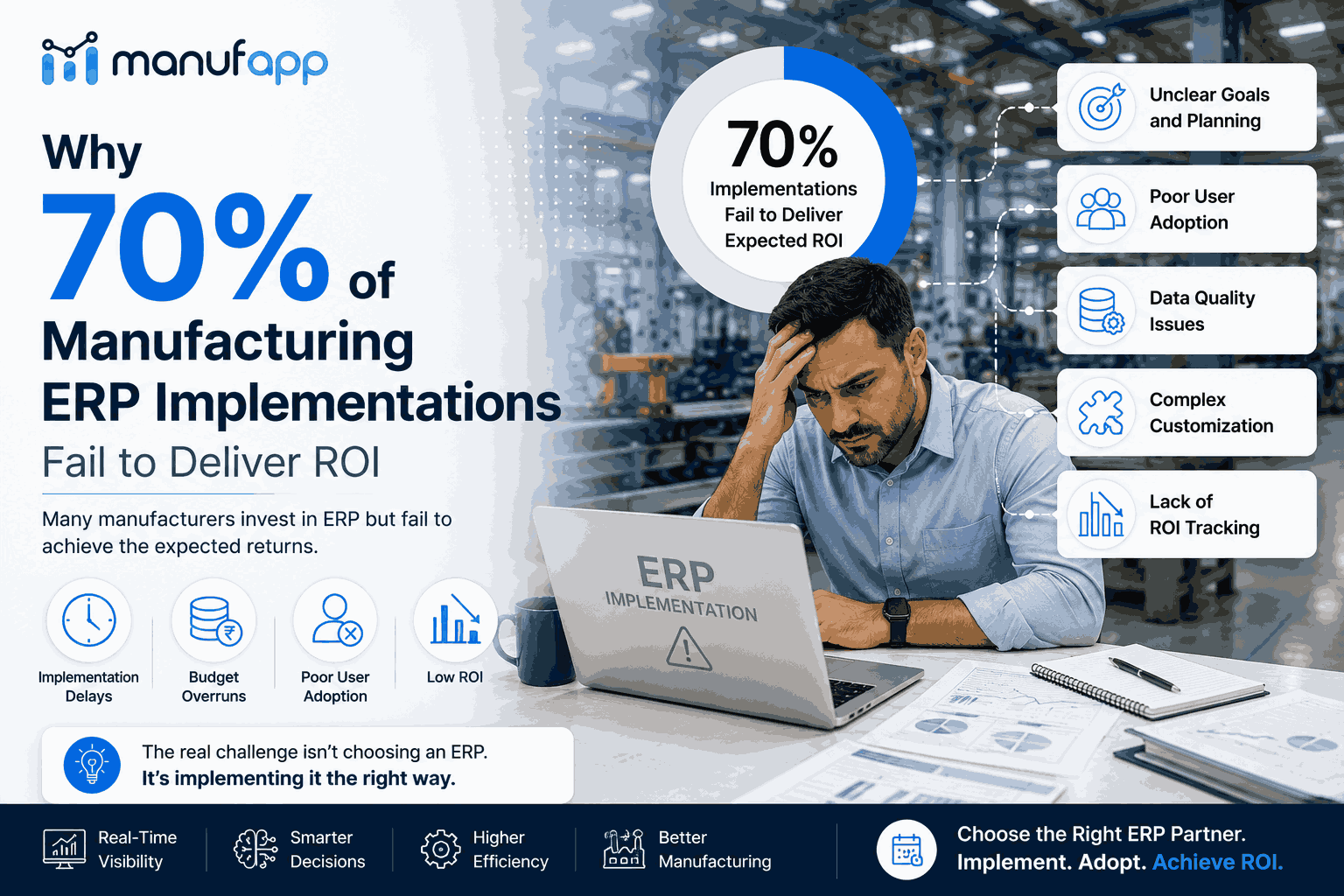
ERP implementation fails when companies focus only on software and ignore process discipline.
Common challenges include:
| Challenge | Solution |
| Poor data accuracy | Standardise master data |
| Team resistance | Train users early |
| Lack of management involvement | Leadership participation |
| Over-customisation | Use standard workflows |
| No shop floor adoption | Mobile & barcode systems |
| Weak planning process | Define SOPs first |
ManufApp follows a phased implementation approach, which makes factory digitisation easier for Indian manufacturers.
How Much Does Manufacturing ERP Cost in India?
Manufacturing ERP pricing depends on:
- Factory size
- Number of users
- Modules required
- Integration needs
- Number of plants
- AI feature requirements
ManufApp offers:
- Lite Plan
- Pro Plan
- Enterprise Plan
Pricing is subscription-based and customised according to operational requirements.
Is AI the Future of ERP Manufacturing?
Yes. AI is rapidly changing production planning.
Modern AI-powered Manufacturing ERP systems can:
- Predict machine failures
- Recommend schedules
- Forecast delays
- Detect production anomalies
- Optimise inventory
- Improve quality inspection
According to Rootstock’s 2026 manufacturing survey, 94% of manufacturers are already using some form of AI.
This is why AI-powered ERP Manufacturing platforms are becoming the next major investment area for smart factories.
Why Is MES Important Alongside Manufacturing ERP?
ERP manages business processes.
MES manages shop floor execution.
When both systems work together, manufacturers get:
- Real-time production tracking
- Better scheduling accuracy
- Live downtime analysis
- Faster reporting
- Improved traceability
ManufApp combines both ERP and MES capabilities in one connected platform, reducing dependency on multiple disconnected tools.
Frequently Asked Questions
Q1. What is Manufacturing ERP?
A2. Manufacturing ERP is software that helps factories manage production, inventory, planning, purchase, maintenance, and quality operations from one platform.
Q2. What is the difference between ERP and MES?
A2. ERP focuses on business planning and operations, while MES focuses on real-time shop floor execution and production tracking.
Q3. How does ERP improve production planning?
A3. ERP improves production planning by automating scheduling, tracking inventory, balancing machine loads, and providing real-time production visibility.
Q4. Which industries use Manufacturing ERP Software?
A4. Industries including auto components, electronics, fabrication, FMCG, food processing, and machinery manufacturing widely use Manufacturing ERP Software.
Q5. Does Manufacturing ERP support AI features?
A5. Yes. Modern ERP Manufacturing systems include AI-based scheduling, predictive maintenance, quality inspection, and production analytics.
Q6. Can Manufacturing ERP integrate with SAP?
A6. Yes. Platforms like ManufApp integrate with SAP B1, SAP ECC, Tally, Zoho, and other enterprise systems.
Q7. How long does ERP implementation take?
A7. Implementation timelines depend on factory size and complexity. Most phased implementations take a few weeks to several months.
Q8. Why is real-time production visibility important?
A8. Real-time visibility helps manufacturers reduce delays, monitor machine performance, improve planning accuracy, and make faster operational decisions.
Conclusion
Production planning is no longer just about scheduling machines.
Modern manufacturers need real-time visibility, AI-driven scheduling, inventory intelligence, and connected shop floor operations.
That is why more factories are adopting Manufacturing ERP Software integrated with MES capabilities.
With AI-powered features, real-time dashboards, and 300+ successful implementations, ManufApp helps manufacturers improve planning accuracy, reduce downtime, and scale operations efficiently.
Book a Free Demo
See how ManufApp can improve your production planning, scheduling, and factory visibility.