

Production Operations Management helps factories control the complete journey from planning to dispatch. Most factories do not lose output because of one big failure. They lose it in small gaps between planning, material, production, quality, maintenance, and dispatch. ManufApp helps close these gaps with real-time MES and Manufacturing ERP visibility across 300+ shop floors.
| Key Area | What Usually Goes Wrong | How ManufApp Helps |
| Planning | Schedule is made without live shop floor reality | Machine-wise planning and load visibility |
| Inventory | Material looks available but is not ready for production | Real-time stock and batch tracking |
| Production | Actual output is updated late | MES-based production tracking |
| Quality | Rejections are found after production is counted | In-process quality checks |
| Maintenance | Downtime is recorded but not linked to planning | Maintenance AI and downtime analysis |
| Dispatch | Finished goods are not clearly mapped to order priority | Order and dispatch visibility |
What Is Production Operations Management in Manufacturing?
Production Operations Management is the process of managing everything that happens between production planning and final dispatch.
It connects planning, raw material availability, machine capacity, operator allocation, quality checks, maintenance, work-in-progress movement, and dispatch readiness.
In a real factory, production does not move in a straight line. A plan may be correct in the morning, but by afternoon, a machine breakdown, material shortage, tool delay, or quality rejection can change everything.
That is why Production and Operations Management is not only about making a schedule. It is about keeping the schedule alive with real-time data.
Why Do Factories Lose Output Between Planning and Dispatch?
Factories usually lose output because planning and execution are not connected properly.
The planning team may prepare a production schedule based on order priority and machine capacity. But the shop floor may face a completely different situation. Material may not be issued. A machine may be under maintenance. An operator may be unavailable. A batch may be waiting for inspection.
This gap creates a difference between planned output and dispatchable output.
For example, a factory may plan 10,000 units in a day. The shop floor may produce 9,000 units. After quality checks, only 8,300 units may be accepted. Finally, because of packing or documentation delays, only 7,800 units may be dispatched.
So the factory did not lose output in one place. It lost output at every stage.
Where Does Output Loss Usually Happen Inside a Factory?
Output loss usually starts when planning is done without live production data.
Many manufacturers still depend on Excel sheets, WhatsApp updates, manual registers, and end-of-shift reports. These methods may work for small operations, but they become risky when order volume, product variety, and customer pressure increase.
Planning Without Real-Time Data
A production plan is only useful if it reflects the current factory situation.
If a planner does not know the actual machine status, current WIP, pending quality approvals, material shortages, or manpower availability, the plan becomes unrealistic.
This is where a Manufacturing ERP with MES capability becomes important. ManufApp connects planning with production tracking, inventory, quality, maintenance, and shop floor execution so that managers do not work with outdated information
Material Delay Before Production Starts
Material availability is one of the most common reasons for lost output.
In many factories, the ERP may show stock available, but the shop floor still waits. The material may be in the store, under quality hold, reserved for another order, or not issued to the correct line.
This creates idle time even when machines and operators are available.
A strong ERP Manufacturing system connects inventory, purchase, planning, and production. This helps planners confirm material readiness before releasing the schedule.
Late Production Reporting
When production data is updated at the end of the shift, the management team is already late.
If a machine stops at 11 AM but the report comes at 7 PM, the factory loses the opportunity to recover during the same day. This delay affects order commitment, dispatch planning, and customer communication.
ManufApp supports barcode-based production tracking, work order visibility, production trends, and machine-wise cycle time analysis. This helps teams see what is happening on the shop floor while production is still running.
Quality Rejections After Production Is Counted
Many factories count produced quantity as output. But real output is the quantity that can be dispatched.
If 5,000 pieces are produced and 600 fail quality inspection, the actual dispatchable output is much lower. This is why quality must be connected with production operations.
ManufApp supports inward QC, in-process QC, CTQ parameters, rejection tracking, and department-wise quality analysis. This helps manufacturers find quality issues earlier instead of discovering them at the final stage.
Downtime That Does Not Change the Plan
Machine downtime is not only a maintenance problem. It is also a planning problem.
If a machine is down for two hours, the production schedule should change immediately. But in many factories, downtime is recorded only for reporting, not for live decision-making.
ManufApp’s Maintenance AI helps technicians with faster guidance during breakdowns, while maintenance dashboards help teams track downtime, preventive schedules, corrective actions, and spare parts.
What Is the Difference Between Planned Output and Dispatchable Output?
Planned output is what the factory expects to produce.
Dispatchable output is what the factory can actually send to the customer after production, quality, packing, documentation, and order allocation are complete.
| Output Type | Meaning |
| Planned Output | Quantity expected as per schedule |
| Actual Output | Quantity produced on the shop floor |
| Accepted Output | Quantity approved after quality check |
| Dispatchable Output | Quantity ready for customer delivery |
Why This Difference Matters
Many factories feel they are producing enough, but still miss dispatch targets.
This happens because they measure production quantity but not dispatch readiness. A factory may complete production, but if inspection, packing, labelling, documentation, or finished goods allocation is pending, the order is still not ready.
Good Production Operations Management focuses on the full chain, not just machine output.
How Does Poor Production Operations Management Affect Factory Performance?
Poor Production Operations Management creates silent losses.
The first impact is delivery delay. When production status is unclear, the dispatch team cannot plan properly. Trucks, packing material, invoices, and customer commitments all get affected.
The second impact is high inventory. When factories do not trust their planning accuracy, they start keeping extra stock. This blocks working capital and increases storage pressure.
The third impact is lower machine utilisation. Machines may be available, but jobs may wait due to material shortage, operator unavailability, tool delay, or quality hold.
The fourth impact is poor management review. Instead of solving problems early, teams spend time finding out what went wrong yesterday.
According to industry research highlighted in the ManufApp knowledge base, predictive maintenance can reduce unplanned downtime by 30–50%, and AI quality inspection can improve first-pass yield by 5–10%. These improvements matter because even small operational gaps become large output losses at scale.
How Can Manufacturing ERP Reduce Output Loss?
A Manufacturing ERP reduces output loss by connecting all departments into one system.
Planning, inventory, production, quality, maintenance, purchase, and dispatch stop working in isolation. Everyone sees the same operational truth.
Manufacturing ERP Creates One Source of Truth
In manual systems, every department has its own version of data.
The planner has one Excel file. The store team has another register. The production supervisor has a manual sheet. The quality team has separate inspection records.
This creates confusion.
A Manufacturing ERP Software brings these records into one connected platform. When material is issued, production starts, quality is checked, or dispatch is cleared, the information updates in the system.
Manufacturing ERP Improves Decision Speed
Production loss becomes expensive when decisions are delayed.
If a machine breaks down, the planner should know. If material is short, purchase should know. If rejection increases, quality and production should know. If dispatch is at risk, management should know.
This is where ERP Manufacturing becomes valuable. It does not only store data. It helps teams act faster.
How Does ManufApp Help Factories Control Planning-to-Dispatch Operations?
ManufApp, built by WYNTOK Technologies, is an AI-powered MES and Manufacturing ERP platform designed for Indian manufacturers.
It helps factories manage inventory, production, planning, orders, purchase, quality, maintenance, subcontracting, tool management, and costing in one connected system.
ManufApp Connects Planning With Shop Floor Execution
ManufApp helps planners create machine-wise schedules and compare them with actual shop floor performance.
This reduces the common gap between what was planned and what actually happened.
ManufApp Improves WIP Visibility
In multi-stage manufacturing, jobs often get stuck between departments.
ManufApp gives better WIP visibility through work order tracking and barcode-based production updates. This helps teams identify whether a job is waiting for machine availability, quality approval, material, tool change, or dispatch clearance.
ManufApp Supports Real-Time Factory Decisions
With real-time dashboards, managers can see production progress without waiting for end-of-day reports.
This helps factories take corrective action during the shift, not after the shift is over.
What Role Does AI Play in Production Operations Management?
AI helps factories move from reactive control to predictive control.
Traditional systems tell you what happened. AI-powered systems help you understand what may happen next and what action should be taken.
Maintenance AI
ManufApp’s Maintenance AI helps technicians during breakdowns by giving instant answers and fix suggestions.
This reduces dependency on senior technicians and helps machines return to production faster.
IMS Computer Vision Monitoring
ManufApp’s IMS uses computer vision to monitor shop floor activity and detect stoppages.
This is useful for factories where IoT installation is difficult, expensive, or not possible on every machine.
Document AI
ManufApp’s Document AI digitises records and extracts important data from documents.
This helps manufacturers reduce paper dependency and find production-related information faster.
Together, these AI features make ManufApp more than a traditional ERP. It becomes a smarter production operations layer for the factory.
Which Factory Metrics Should Be Tracked to Reduce Output Loss?
Factories should track metrics that show where output is getting blocked.
| Metric | What It Reveals |
| Plan vs Actual Production | Whether the factory met the schedule |
| Accepted Output | How much production passed quality |
| Dispatchable Output | How much is ready for customer delivery |
| Machine Downtime | Where capacity was lost |
| WIP Ageing | Where jobs are stuck |
| Schedule Adherence | How realistic the plan was |
| Rejection Rate | How much output was lost in quality |
| On-Time Dispatch | Whether production converted into delivery |
The Most Important Metric
The most useful metric is not only actual production.
The real metric is dispatchable output.
This tells factory leaders whether production has actually converted into customer-ready goods.
How Should a Factory Improve Production Operations Management?
The best way to improve Production and Operations Management is to digitise the full flow from planning to dispatch.
A factory should first standardise its master data, including item codes, BOMs, machines, routing, cycle times, and quality parameters. Without clean data, even the best ERP will struggle.
After that, planning should be connected with inventory. No production schedule should be released unless material readiness is clear.
The next step is real-time production tracking. This can be done through barcode, mobile app, MES, machine integration, or computer vision, depending on the factory environment.
Quality should also be linked directly with production. Managers should track accepted quantity, not only produced quantity.
Finally, dispatch readiness should be reviewed daily. A finished product is only useful when it is approved, packed, documented, and ready to ship.
Why Is Production and Operations Management Important for Indian Manufacturers in 2026?
Indian manufacturers are facing increasing pressure from customers, OEMs, export buyers, and compliance requirements.
With Make in India, PLI-led growth, higher customer expectations, and rising competition, factories cannot depend only on manual coordination.
They need live visibility.
This is especially important for sectors like auto components, electronics, electrical, fabrication, FMCG, machinery, furniture, wire and cable, and food manufacturing.
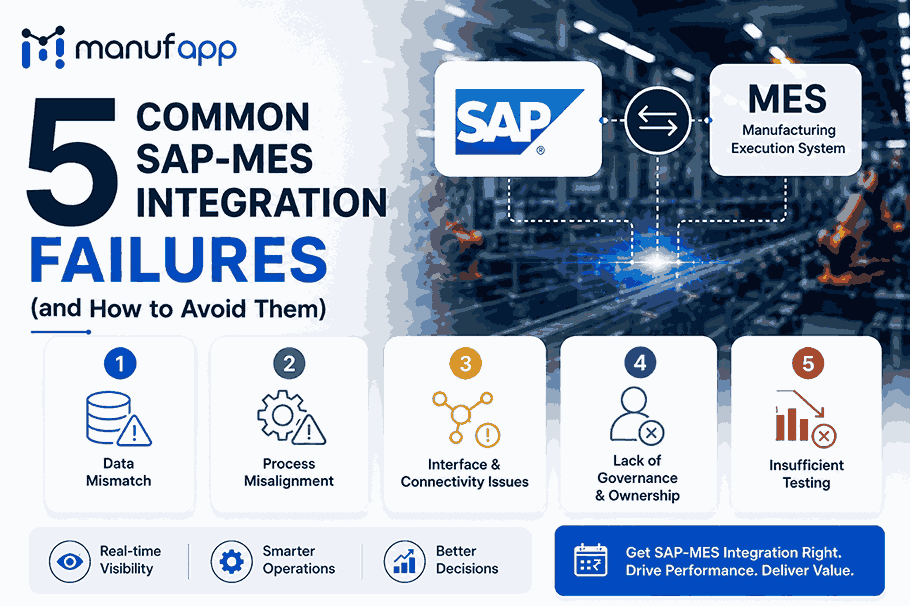
ManufApp is built for Indian manufacturing realities. It supports SAP B1, SAP ECC, Zoho, Tally, PLC, OPC, weighing machines, and testing equipment integrations, which helps manufacturers connect existing systems instead of replacing everything at once.
When Should a Factory Consider ManufApp?
A factory should consider ManufApp when production delays are frequent, dispatch commitments are missed, WIP is difficult to track, quality issues are found late, or management depends too much on manual follow-ups.
It is also useful when the factory already has ERP but still lacks real-time shop floor visibility.
Best Fit for ManufApp
ManufApp is suitable for manufacturers that want to connect production planning, MES execution, inventory, quality, maintenance, and dispatch in one platform.
It is especially useful for growing factories that need better control but do not want overly complex enterprise software.
What Is the Final Takeaway?
Factories do not lose output only because machines stop.
They lose output because planning, production, quality, maintenance, inventory, and dispatch are not connected in real time.
Production Operations Management helps close this gap.
With ManufApp’s AI-powered MES and Manufacturing ERP, manufacturers can see where output is stuck, why dispatch is delayed, and what action is needed before the issue becomes a customer escalation.
CTA: Book a Free Demo to see how ManufApp can improve your planning-to-dispatch visibility.
FAQ
What is Production Operations Management?
Production Operations Management is the process of managing production from planning to dispatch. It connects planning, material, machines, quality, maintenance, WIP, and dispatch readiness.
Why do factories lose output between planning and dispatch?
Factories lose output because the production plan is often not connected with live shop floor data. Material delays, downtime, WIP movement, quality rejections, and dispatch delays reduce final output.
How does Manufacturing ERP improve production operations?
Manufacturing ERP connects planning, inventory, production, quality, maintenance, and dispatch in one system. This gives managers better visibility and faster decision-making.
What is the difference between actual output and dispatchable output?
Actual output is what the shop floor produces. Dispatchable output is what has passed quality, packing, documentation, and order allocation.
Why is MES important in Production Operations Management?
MES gives real-time shop floor visibility. It helps track work orders, machine status, downtime, production quantity, and process-level delays.
How does ManufApp reduce production delays?
ManufApp connects production planning, MES tracking, inventory, quality, maintenance, and dispatch visibility. This helps manufacturers identify bottlenecks early and take corrective action faster.
Is ManufApp suitable for Indian SMEs?
Yes. ManufApp is designed for Indian manufacturers and supports growing SMEs as well as larger factories. It offers Lite, Pro, and Enterprise plans based on business needs.