

What is ERP for Small Manufacturing Companies?
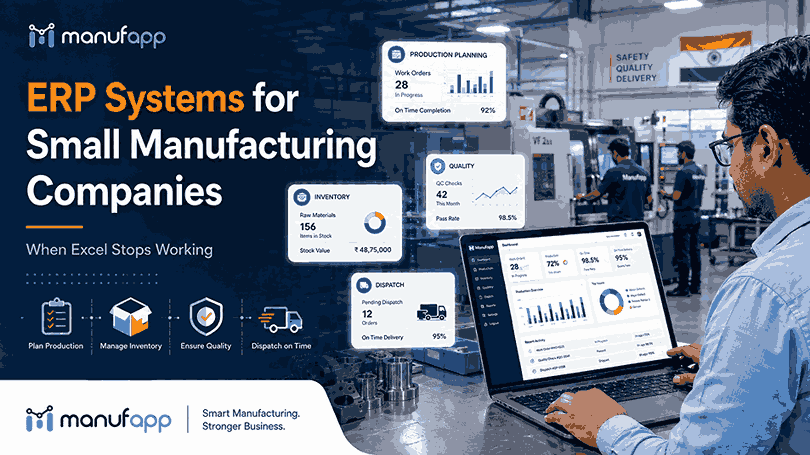
ERP (Enterprise Resource Planning) for small manufacturing companies For small manufacturers, this means fewer missed orders, less guesswork around inventory, and greater visibility into what is really going on on the shop floor. Platforms like ManufApp are built specifically for this — helping small and mid-sized manufacturers move off spreadsheets without the complexity of enterprise ERP systems.
How ManufApp Helps Small Manufacturers
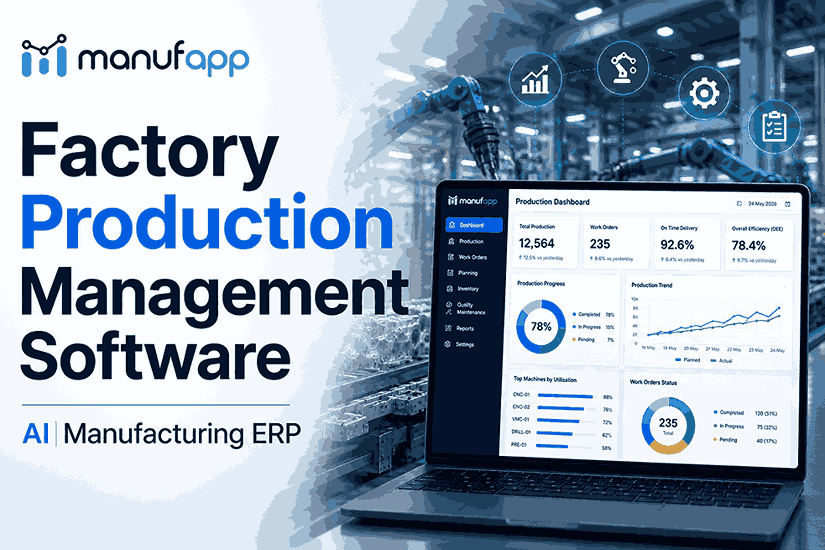
ManufApp is a cloud-based ERP designed specifically for small and mid-sized manufacturing businesses in India. Unlike generic ERP systems, it connects inventory, production planning, quality inspection, purchase, and dispatch into one platform — built to match how small factories actually operate, without the cost or complexity of enterprise systems like SAP or Oracle.
Why ERP is Important for Small Manufacturers
If you run a small manufacturing business, you’re dealing with raw materials, machine schedules, staff, customer orders and supplier delays — often all at once. The majority of owners begin by controlling this with spreadsheets, WhatsApp groups and memory. It works until it stops.
Usual problems that bring small manufacturers to ERP:
- Stockouts and excess inventory — not knowing what’s actually in stock leads to production delays or overbuying
- Missed or delayed orders — no central view of order status across departments
- Manual, error-prone reporting — end-of-day reports built by hand, often inaccurate
- No real-time visibility — owners find out about problems (machine downtime, quality issues, delays) after the fact, not while they’re happening
- Disconnected systems — accounting in one tool, production tracking in another, nothing talks to each other
An ERP system pulls all of this into one place, so a small manufacturer can actually run the business instead of constantly firefighting.
What is the Cost of ERP for Small Manufacturing Companies?
Cost is the first question small manufacturers always want to know. Cost varies depending on company size, number of users and modules required. In India, ERP pricing for small manufacturers generally falls into a few categories:
Entry-level cloud ERP: Lower monthly per-user pricing, suited for businesses just starting to move off spreadsheets, typically covering inventory, production, and basic reporting.
Mid-tier ERP: Adds modules like quality management, dispatch planning, and multi-location support, priced higher per user with more implementation support.
Enterprise ERP (SAP, Oracle, Dynamics 365): Significantly higher setup and licensing costs, generally not cost-effective for small manufacturers unless they have complex, multi-plant operations.Note: exact pricing depends on vendor, user count, and modules — always request a quote based on your specific setup rather than relying on general figures.
And don’t forget implementation time, training and data migration – all of which are often overlooked but can have a direct impact on how quickly you realise ROI.
Key Features of ERP for Small Manufacturers
Not every ERP feature is as important to a small manufacturing business. Here’s what to focus on:
Inventory Control
Real-time tracking of raw materials, WIP and finished goods with alerts when stock gets low – this alone solves most stock out and over stock issues.Production Planning and Scheduling
Schedule by machine and by shift with visibility into planned vs. actual output so delays are caught early, not at dispatch.Quality & Inspection
Digital recording of inspection results, rejection reasons and rework – critical for consistency and for meeting customer or export compliance requirements.Purchasing Management
Automated purchase orders, vendor mapping and inward quality checks to reduce manual follow ups with suppliers.Order Tracking & Dispatch
Order wise progress tracking and dispatch alerts for timely meeting of customer commitments.Reports and Analytics
Daily production reporting and downtime analysis without the need for manual compilation.Under Inventory Control
ManufApp’s Inventory module tracks RM, WIP, and FG stock in real time, with automated low-stock alerts and inventory reconciliation.Under Production Planning and Scheduling,
ManufApp supports auto-scheduling, machine-wise planning, and planned vs. actual tracking to catch delays before they affect dispatch.Under Quality & Inspection
ManufApp digitizes inspection records, rejection tracking, and rework — helping small manufacturers meet customer and export compliance requirements without manual paperwork.GST and Compliance Why it is Important for Indian Manufacturers
ERP is not just a tool for manufacturing operations in India, but it also helps with GST compliance and e-invoicing requirements. A connected system keeps records of purchase, production and dispatch in sync with accounting which reduces errors while filing GST and makes audit smooth. This is especially true for MSMEs that are growing and are under more scrutiny on documentation and reporting.
Cloud ERP vs. On-Premise ERP vs. ManufApp: Which Is Right for Small Manufacturers?
Factor Cloud ERP (Generic) On-Premise ERP ManufApp Upfront cost Lower Higher (hardware + setup) Low — subscription-based, no heavy infrastructure investment IT infrastructure needed Minimal Significant Minimal — cloud-hosted, managed end-to-end Access Anywhere, any device Limited to on-site systems Anywhere via web + dedicated mobile app for shop floor updates on the go Maintenance Handled by vendor Handled in-house Fully handled by ManufApp — updates, hosting, and support included in subscription Scalability Easier to scale up/down Requires additional hardware Built for multi-factory operations — manage multiple locations from one platform as you grow Implementation approach Varies by vendor Long, complex rollouts Structured, phased implementation to minimize disruption to daily operations AI/Automation Rare in generic cloud ERP Not typical Includes Maintenance AI, Intelligent Monitoring (auto-detects stoppages), and Document AI (digitizes records)Industry expertise Generic Generic Backed by experience across 300+ shop floors, with free consultation before implementation Real-time visibility Depends on vendor Limited, manual reporting common Live shop floor data — production, downtime, and quality tracked in real time
For most small manufacturers, cloud ERP is the more practical choice — lower upfront investment, less dependency on in-house IT, and the flexibility to access data remotely. ManufApp is built specifically as a cloud-first ERP for small and mid-sized manufacturers, so you get this flexibility without needing an in-house IT team.
7 Common Mistakes Small Manufacturers Make When Choosing ERP
Avoiding these mistakes starts with choosing an ERP built specifically for manufacturing. ManufApp is designed to address each of these directly — manufacturing-specific modules (not generic business software), a structured phased implementation to prevent rushed rollouts, free consultation before you commit, and native integration with Tally, Zoho, and SAP so you’re not left doing extra manual work.
- Choosing a generic ERP instead of one built for manufacturing — generic business software often lacks BOM management, shop-floor tracking, and quality modules.
- Underestimating implementation time — rushing the rollout leads to incomplete data migration and poor adoption.
- Ignoring staff training — even the best ERP fails if the team doesn’t use it properly.
- Overbuying features — paying for enterprise-level modules a small factory doesn’t need yet.
- Not checking integration support — if the ERP doesn’t connect with existing accounting tools (Tally, Zoho), it creates more manual work, not less.
- Skipping a trial or demo — committing without seeing how the system handles your actual production workflow.
- No clear ROI benchmark — not defining what success looks like (e.g., reduced downtime, faster dispatch) before implementation, making it hard to measure impact later.
10 Questions to Ask Before Choosing an ERP for Your Factory
- Does it support manufacturing-specific processes (BOM, production planning, quality checks) or is it generic business software?
- What’s the total cost, including implementation and training — not just the monthly subscription?
- How long does implementation typically take for a business our size?
- Does it integrate with our existing accounting software (Tally, Zoho, SAP)?
- Is it cloud-based, and can our team access it remotely?
- What kind of ongoing support is included after go-live?
- Can it scale as we add more product lines or locations?
- Does it support GST-compliant reporting and documentation?
- Can we see a demo using data similar to our actual operations?
- ManufApp is built to answer most of these questions directly — with manufacturing-specific modules, transparent implementation timelines, and integration support for Tally, Zoho, and SAP.
Frequently Asked Questions
Q1. Which is the best ERP for small manufacturing business?
The best ERP for a small manufacturer is one that’s built for manufacturing — not generic business software — with strong inventory, production planning, and quality modules. ManufApp is one such platform, designed specifically for small and mid-sized Indian manufacturers.
Q2. How much will it cost to implement ERP in a small factory in India?
Costs vary depending on vendor, number of users, and modules chosen. ManufApp offers entry-level cloud ERP pricing suited for small manufacturers — request a quote based on your specific setup for an accurate number.
Q3. How much time does it take to implement ERP in a small manufacturing company?
Implementation timelines vary, depending on the complexity of the business and data readiness, but smaller manufacturers generally roll out faster than large enterprises since there is less data and fewer departments to migrate.
Q4. Is cloud ERP secure for manufacturing data?
Yes. Reputable cloud ERP vendors utilise encrypted storage and regular backups, often making data more secure than on-premise systems that rely on in-house IT maintenance.
Q5. How does ERP help in GST compliance?
Yes. ERP systems that combine production and purchase data with accounting help ensure correct, consistent records for GST filing and help reduce manual reconciliation errors.
Q6. Do small manufacturers need ERP or is Excel enough?
Excel is good for small scale work but as order volume, inventory complexity and number of staff increase, spreadsheets become error-prone and disconnected. Most manufacturers move to ERP when manual tracking begins to cause missed orders or stock discrepancies.
This guide reflects common questions and challenges we see from small manufacturing businesses evaluating ERP systems. Want to see how ManufApp fits your factory’s specific workflow? Book a free demo and see your production data live during the call.