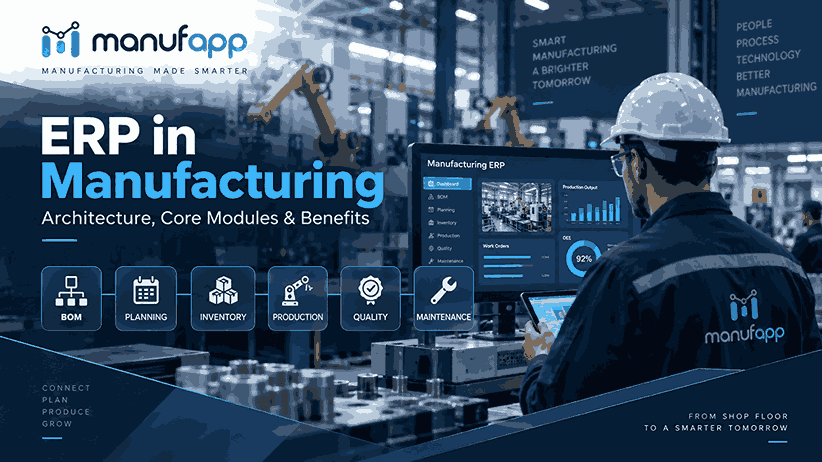


ERP in Manufacturing is a connected system that plans and controls orders, materials, production, inventory, quality, maintenance and costing from one data layer. A manufacturing ERP turns a customer order into an executable factory plan, then tracks what was produced, consumed, rejected, delayed and dispatched.
| Quick Answer | Meaning |
| ERP Manufacturing | ERP designed around factory operations |
| Core Architecture | Data → Planning → Execution → Control → Integration |
| Main Modules | Production, Inventory, Planning, Purchase, Quality, Maintenance, Costing |
| BOM | List of materials required to manufacture a product |
| ERP + MES | Connects business planning with actual shop-floor execution |
For a factory owner, the real value of ERP is not simply replacing Excel. It is creating a common operational system where production, stores, purchase, quality, maintenance and management work with the same information.
That distinction matters because a factory can have accounting software and still struggle with material shortages, delayed work orders, incorrect production status and last-minute dispatch problems.
What Is ERP in Manufacturing?
ERP in manufacturing is software that connects commercial and factory operations in one system. It manages how customer demand becomes material requirements, production plans, work orders, inventory movements, quality records and finished-goods dispatch while maintaining a common source of operational and financial data.
ERP stands for Enterprise Resource Planning.
A normal ERP may focus heavily on sales, purchase, accounting and inventory. An ERP Software for Manufacturing Industry needs to understand what happens between receiving an order and shipping the finished product.
Suppose your customer orders 500 electrical assemblies.
Your ERP should help answer:
What needs to be manufactured? → Which materials are required? → Are those materials available? → Which machines and shifts should be used? → What is currently under production? → Has quality approved it? → When can it be dispatched?
That is the practical meaning of ERP manufacturing.
What Is the Architecture of a Manufacturing ERP System?
Manufacturing ERP architecture is the structure through which factory data moves from master records and customer orders into planning, production execution, inventory, quality and management reporting. A strong architecture connects each operational layer instead of allowing production, stores, purchase and finance to maintain separate versions of the same information.
A practical manufacturing ERP architecture can be understood in five layers.
1. Master Data Layer
Everything starts with structured master data.
This includes item masters, raw materials, finished goods, machines, suppliers, customers, warehouses, units of measurement, BOMs and production routes.
Incorrect master data creates problems further down the process. If the BOM quantity is wrong, planning and procurement calculations may also be wrong.
2. Planning Layer
The planning layer converts demand into an actionable manufacturing plan.
Sales orders, forecasts and required delivery dates are evaluated against material availability, machine capacity and production requirements.
This is where production planning, MRP, machine scheduling and shift allocation become important.
3. Execution Layer
Planning tells you what should happen. Execution records what actually happens.
Work orders reach the shop floor, operators report production, material is issued, processes are completed and production quantities are captured.
Factories that require deeper real-time execution typically combine ERP with a Manufacturing Execution System (MES).
4. Control Layer
Production should not operate separately from inventory, quality or maintenance.
The control layer connects production with stock consumption, quality inspection, rejection, machine downtime, finished inventory and manufacturing costing.
Management can therefore understand not only whether an order was completed, but what happened while producing it.
5. Integration Layer
Modern factories rarely run on one isolated application.
Manufacturing ERP may need to exchange information with financial ERP, machines, testing equipment, weighing systems or other business platforms.
ManufApp, for example, supports integrations with SAP Business One, SAP ECC, Zoho, Tally and factory systems through APIs, PLC and OPC connectivity.
What Is Bill of Materials (BOM) in ERP?
A Bill of Materials or BOM in ERP is the structured list of raw materials, components and quantities required to manufacture a product. It tells the ERP what must be available before production begins and becomes a foundation for material planning, procurement, inventory consumption and production costing.
Think of the BOM as the manufacturing recipe for a product.
If your factory manufactures an electrical control panel, its BOM might contain an enclosure, switches, relays, terminals, wires, connectors and fasteners.
If one finished unit requires four connectors and you plan to manufacture 500 units, your system can calculate the expected component requirement from the BOM.
A manufacturing ERP should also help control BOM versions and revisions. This becomes especially important in electronics, machinery, auto components and other industries where product designs change.
The BOM explains what goes into the product. It should not be confused with routing, which explains how the product is manufactured.
How Do BOM, Routing, MRP and Work Orders Work Together?
These four concepts form an important manufacturing chain.
BOM tells the ERP which components are needed.
Routing defines the sequence of manufacturing operations or processes.
MRP calculates which materials are needed and when they are needed based on demand, inventory and production requirements.
Work orders authorise the factory to manufacture a defined quantity according to the planned process.
A simplified flow looks like this:
Customer Order → BOM → Material Requirement → Production Plan → Work Order → Shop-Floor Production → Quality → Finished Goods → Dispatch
When these stages are connected, a change in one area can become visible to another.
For example, if a required component is unavailable, planning should see that shortage before committing an unrealistic production schedule.
What Is MRP in Manufacturing ERP?
Material Requirements Planning (MRP) is the ERP process used to determine what materials a factory needs, how much is required and when those materials should be available. It connects production demand with BOM quantities, available inventory, purchase requirements and planned manufacturing dates.
MRP is particularly useful when a factory handles hundreds or thousands of components.
Without systematic planning, the store may appear to have enough total stock while the production line is still missing one critical part.
The objective is not simply to buy more material. Good MRP helps purchasing teams buy the right material at the right time according to production demand.
That also makes procurement more closely connected to actual manufacturing requirements.
What Are the Core Manufacturing ERP Modules?
Manufacturing ERP modules are specialised functions that manage individual factory processes while sharing the same operational data. The most important modules normally cover production, planning, inventory, purchasing, quality, maintenance, orders and costing, with additional capabilities required for subcontracting, tools, traceability and shop-floor execution.
For most factories, these are the modules that matter most:
Production Management
Production management converts planned demand into work that can be executed.
It should capture work-order progress, production quantities, process status and actual output.
Production Planning and Control
Planning determines what should run, where and when.
Machine capacity, shifts, priorities, delivery commitments and material availability all influence the schedule.
When an urgent customer order arrives or a machine becomes unavailable, the production team needs visibility to adjust the plan rather than rebuild it manually in spreadsheets.
Inventory Management
Manufacturing inventory is more complex than simply knowing the closing stock quantity.
You may need visibility into raw material, WIP, finished goods, batch or lot information, ageing, material movement and production consumption.
Purchase Management
Purchase should be driven by actual production requirements.
By connecting MRP and purchasing, teams can identify material shortages, create purchase requirements and monitor vendor-related dependencies before they affect production.
Quality Management
Quality belongs inside the manufacturing flow.
Inward quality inspection can control incoming material, while in-process quality checks help ensure that production meets defined parameters before material reaches the next stage.
Maintenance Management
Equipment availability has a direct impact on production commitments.
Maintenance modules help teams manage preventive schedules, breakdowns, corrective actions, spare parts and machine downtime instead of treating maintenance as an isolated department.
Costing, Tools and Subcontracting
Manufacturing costs depend on more than the material purchase price.
Process costs, subcontracting, tools and other operational factors affect the real cost of producing an item.
ManufApp brings these processes together through 10 core manufacturing modules covering Inventory, Production, Planning, Orders, Purchase, Quality, Maintenance, Subcontracting, Tool Management and Costing.
How Does Manufacturing ERP Work From Customer Order to Dispatch?
A manufacturing ERP creates a connected transaction trail from customer demand to final dispatch. Instead of each department maintaining a separate sheet, the order can drive material planning, purchasing, production scheduling, work-order execution, quality approval, inventory updates and dispatch readiness.
Consider a customer order that must ship next Friday.
Sales enters the order and committed quantity.
Planning checks required production and capacity.
The BOM identifies material demand.
Inventory identifies what is available.
MRP identifies shortages.
Purchase works on missing material.
Production receives the planned work order.
Quality checks the required stages.
Finished quantities update inventory.
Dispatch can then see what is actually ready.
This creates something factories often struggle to achieve with spreadsheets: a continuous connection between promise, plan and execution.
What Are the Main Benefits of ERP in Manufacturing?
The biggest benefit of ERP manufacturing is operational coordination. It allows departments to work from connected information, giving management clearer visibility into production status, material availability, quality, maintenance, delivery commitments and costs instead of making decisions from disconnected spreadsheets and delayed reports.
The practical benefits include:
- Better production visibility: know what is planned, running, delayed and completed.
- More reliable material planning: connect BOM demand with stock and purchasing.
- Stronger inventory control: track how material moves from stores into production and finished goods.
- Improved quality traceability: connect inspections and rejections with the relevant production process.
- Maintenance visibility: understand how machine availability affects the production plan.
- Clearer costing: compare material and process information within the manufacturing workflow.
The biggest change is usually organisational.
Instead of sales asking planning, planning calling stores and stores asking purchase, teams can work from one connected operational flow.
What Is the Difference Between Manufacturing ERP and MES?
Manufacturing ERP primarily plans and coordinates business and factory resources, while MES controls and records production execution closer to the shop floor. ERP answers what should be produced and what resources are required; MES provides deeper visibility into what is actually happening during production.
| Manufacturing ERP | MES |
| Orders and demand | Shop-floor execution |
| BOM and MRP | Work-order progress |
| Inventory and purchasing | Production data capture |
| Planning and costing | Machine/process visibility |
| Business-wide control | Real-time production control |
You do not always need to choose one or the other.
For factories that need deeper execution visibility, ERP + MES together can provide a more complete architecture.
ManufApp is designed around this connected approach. Its Manufacturing ERP capabilities sit alongside MES functionality, allowing planning and management information to connect with shop-floor execution.
Why Does ERP Manufacturing Need Real-Time Shop-Floor Visibility?
ERP loses operational value when production information reaches it too late. Real-time shop-floor visibility connects planned work with actual progress so managers can identify production delays, stoppages, quantity gaps and changing completion estimates before those issues turn into missed delivery commitments.
Imagine your ERP says a work order is scheduled for today.
That does not automatically mean production has started.
Perhaps material has not reached the machine. Perhaps the operator is waiting for a tool. Perhaps the machine has stopped.
An ERP record that only gets updated at the end of the shift tells you what happened.
A connected MES environment helps you understand what is happening now.
That difference is especially important for production managers responsible for multiple machines, lines or orders.
How Is AI Changing Manufacturing ERP in 2026?
AI is moving manufacturing ERP from recording transactions towards helping teams understand and respond to operational events. Instead of only storing production and maintenance data, AI-enabled manufacturing systems can assist technicians, monitor factory activity and convert documents into usable digital information.
ManufApp extends its Manufacturing ERP + MES environment through three AI capabilities.
Maintenance AI helps technicians access guidance and suggested actions when dealing with machine problems.
IMS — Intelligent Monitoring System uses computer vision for shop-floor monitoring and stoppage visibility.
Document AI helps digitise factory documents and extract useful information from records that would otherwise remain paper-based.
The important distinction is that AI should solve an operational problem.
Adding an “AI” label to a dashboard does not make a factory intelligent. The useful question is whether the system helps your people detect, decide or act faster.
Which Industries Use ERP Software for Manufacturing Industry?
ERP software for manufacturing industry can support both discrete and process-oriented operations, but workflows must match the way each factory actually manufactures. An auto-component plant, electrical assembly unit, fabrication business and food manufacturer may all need ERP, yet their BOMs, quality controls, traceability and production methods can differ significantly.
ManufApp supports manufacturing environments including electronics, electrical products, auto components, fabrication, furniture, wire and cables, machinery, food and beverages, FMCG and several other factory segments.
This is why industry fit matters during ERP selection.
A generic system may offer “inventory” and “production” modules, but those module names alone tell you very little about whether the software can handle your actual shop-floor workflow.
How Should You Choose ERP Software for a Manufacturing Industry?
Choose manufacturing ERP by testing how well it handles your real production workflow, not by comparing the longest feature list. The right system should connect orders, BOM, MRP, production planning, inventory, quality, maintenance and costing while integrating with any business or machine systems you intend to retain.
Before choosing a system, ask six practical questions:
- Can it model our real BOMs, routings and production processes?
- Can planning see material and capacity constraints before releasing work?
- Can production report actual progress without creating extra administrative work?
- Are inventory, quality and maintenance connected to production?
- Can it integrate with our existing systems?
- Can it scale when we add machines, lines, plants or users?
During a demo, do not ask the vendor to show only dashboards.
Give them one of your actual manufacturing scenarios.
For example: “This machine has gone down, one component is short, and the customer has advanced the delivery date. Show us what happens in the system.”
That demonstration will tell you more about the software than a long feature checklist.
How Does ManufApp Approach ERP Manufacturing Differently?
ManufApp combines Manufacturing ERP, MES and AI so manufacturers can connect business planning with actual factory execution. Built by WYNTOK Technologies, the platform has been implemented across 300+ shop floors and brings production, inventory, planning, quality, maintenance and related factory workflows into one manufacturing environment.
The objective is not to force every manufacturer to replace every existing system.
ManufApp can integrate with SAP Business One, SAP ECC, Zoho and Tally, while shop-floor integrations can extend through PLC, OPC, weighing and testing equipment where required.
This gives manufacturers a practical path to digitisation.
A company already using SAP, for example, may strengthen its shop-floor execution without replacing its core ERP environment.
A growing SME can use ManufApp’s Manufacturing ERP capabilities to build a more connected operational foundation.
When Does a Factory Know It Has Outgrown Spreadsheets?
A factory has usually outgrown spreadsheet-based production control when maintaining the spreadsheet becomes a separate operational job. Multiple versions, manual stock reconciliation, delayed production updates, missed material shortages and constant status calls are signs that information is no longer moving as quickly as the factory itself.
You may be ready for a manufacturing ERP if:
Production planning depends on one employee’s Excel file.
Inventory figures frequently need manual verification.
Sales cannot confidently answer when an order will be ready.
Purchase discovers shortages after production is already due.
Quality records are difficult to connect with specific orders or batches.
Management gets production information only at the end of the day or week.
ERP should remove these information gaps, not simply digitise the same disconnected process.
What Should Factory Owners Remember About ERP Manufacturing?
ERP manufacturing works best when it connects how a factory sells, plans, buys, produces, inspects, maintains and dispatches—not when it becomes another database employees must update. The architecture matters, but the real test is whether information flows naturally from customer demand to shop-floor execution and management decisions.
For students researching industrial technology, the key concepts are straightforward:
ERP = connected business and manufacturing planning.
BOM = what materials make the product.
Routing = how the product is made.
MRP = what materials are required and when.
Work order = instruction to manufacture.
MES = what is actually happening on the shop floor.
For manufacturers, the next question is more practical: can your existing system connect all of these without requiring five spreadsheets and ten follow-up calls?
ManufApp is designed to address that gap through integrated Manufacturing ERP, MES and AI capabilities.
Ready to Connect Planning With Your Shop Floor?
See how ManufApp can connect production, planning, inventory, quality, maintenance and real-time execution for your factory.
CTA: Book a Free Demo
Frequently Asked Questions
What is ERP in manufacturing?
ERP in manufacturing is software that connects customer orders, BOMs, materials, production planning, inventory, purchasing, quality, maintenance and costing. It helps different factory departments work from connected operational information instead of maintaining separate systems.
What are the main manufacturing ERP modules?
Core manufacturing ERP modules typically include production, planning, inventory, purchase, order management, quality, maintenance and costing. ManufApp also includes subcontracting and tool management as part of its manufacturing platform.
What is BOM in manufacturing ERP?
A Bill of Materials (BOM) is the structured list of components and quantities required to manufacture a finished or semi-finished product. ERP uses BOM information for material planning, production requirements, inventory consumption and costing.
What is the difference between ERP and MRP in manufacturing?
ERP manages a broad range of factory and business processes, while MRP focuses specifically on material requirements. MRP normally operates as part of a wider manufacturing ERP environment and calculates what materials are needed according to production demand.
Does manufacturing ERP replace MES?
Not necessarily. ERP focuses more on planning and enterprise-wide manufacturing information, while MES provides deeper control and visibility into production execution. Manufacturers needing both planning and real-time shop-floor control can use an integrated ERP + MES approach.
Is manufacturing ERP useful for small manufacturers?
Yes. A growing manufacturer can benefit when spreadsheets and disconnected systems begin creating production, stock or planning problems. The right system should match current operational complexity while providing room to scale.
Can ManufApp integrate with an existing ERP?
Yes. ManufApp supports integration with SAP Business One, SAP ECC, Zoho and Tally, along with additional API-based connections. This allows manufacturers to strengthen manufacturing and shop-floor capabilities without necessarily replacing existing business systems.
What AI capabilities does ManufApp provide?
ManufApp offers Maintenance AI, IMS (Intelligent Monitoring System) and Document AI. These capabilities support technician guidance, computer-vision-based factory monitoring and digitisation of manufacturing records.