


A fabrication shop may have dozens of beams, columns, braces, plates, and assemblies moving through cutting, drilling, fit-up, welding, inspection, painting, and dispatch at the same time. Many of those components can look almost identical.
This is where a mark number in structural steel becomes critical.
A mark number gives a fabricated member an identity that connects what workers see on the shopfloor with what engineers and detailers see on the drawing. When that identity is wrong, missing, or linked to an outdated drawing, the problem can travel surprisingly far before anybody notices.
A beam fabricated against the wrong mark may still get welded, inspected, painted, loaded, transported, and reach the erection site. By the time the mismatch is discovered, what started as a simple identification error may have become expensive rework and a project delay.
Mark-number control is therefore not just a drawing-office activity. It is a fundamental part of structural steel production control and one of the many common challenges in the fabrication industry when information is managed manually.
What Does a Mark Number in Structural Steel Mean?
A mark number, often called a piece mark, is an alphanumeric identifier used to identify a structural steel member or a group of identical fabricated members on drawings and through the fabrication process.
Examples may look like:
- B12 for a beam
- C05 for a column
- BR07 for a brace
- PL24 for a plate
- G03 for a girder
The actual naming convention varies between fabricators and projects. These examples should therefore not be treated as a universal standard.
The important point is that the mark shown on the physical member corresponds to the mark used in fabrication or erection drawings.
For example, suppose an erection drawing shows beams B21, B22, and B23 at three different grid locations. Even if the beams have a similar section and length, their connections, holes, stiffeners, copes, or orientation may differ.
The mark tells the fabrication and erection teams which member is which.
Mark Number vs Heat Number: They Are Not the Same
One common mistake is to treat the mark number and heat number as interchangeable. They serve different purposes.
A mark number identifies the fabricated member or group of identical members and connects it with the relevant drawings, fabrication stages, inspection records, and erection information.
A heat number identifies the steelmaking heat and supports material traceability back to the relevant mill records or material test certificate.
Similarly, a drawing number identifies a document, while a job card normally represents the work to be performed.
In a well-controlled fabrication process, these identities can be connected.
For example:
Heat 78452 → Raw Plate → Cut Component → Mark PL24 → Assembly B18 → Inspection → Dispatch
This distinction becomes important whenever the project requires material-grade or certificate traceability.
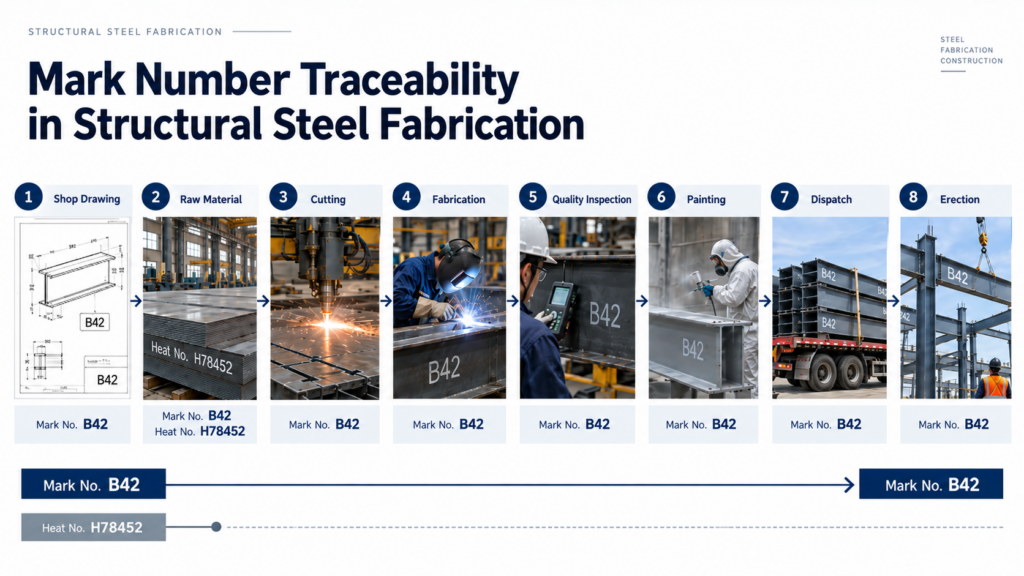
How a Mark Number Moves Through the Fabrication Shop
Mark-number control begins before the first cut is made. It should remain intact through every stage where the physical identity or status of the component can change.
1. Detailing and Shop Drawings
The process typically starts with approved fabrication information.
Detailers define individual members and assemblies based on structural drawings. Marks allow production teams to distinguish the members shown in those drawings.
Consider a fabrication package containing:
- 18 columns
- 64 beams
- 30 braces
- 120 plates
- multiple connection assemblies
The shop does not simply need to know that it has to manufacture 64 beams. It needs to know which beam belongs to which mark, drawing revision, assembly, and ultimately project location.
That identity becomes the reference point for subsequent operations.
2. Raw Material Selection and Cutting
Stores or production teams issue the required plates, sections, angles, channels, or other material against the production requirement.
At this stage, control may involve both material identity and component identity.
Suppose a 12-metre plate has several smaller components nested and cut from it. Each cut component must remain identifiable once it is separated from the parent material.
If PL31 and PL32 have similar dimensions but different hole patterns, losing their identification after cutting can create problems during drilling or fit-up.
Good material management of steel sheets therefore needs to work together with production identification rather than ending when material leaves stores.
3. Drilling, Fit-Up and Welding
The risk becomes higher as components accumulate value.
A cut plate is relatively early in the process. Once it has been drilled, machined, fitted with stiffeners, welded into an assembly, and inspected, considerably more labour has been invested.
Workers therefore need to know:
- which mark they are processing
- which operation is required
- which drawing or revision applies
- which components belong to the assembly
- how much quantity is complete
If identification depends entirely on chalk markings, paper lists, or memory, similar-looking parts can easily be mixed.
4. Inspection, Blasting and Painting
Quality teams also depend on correct identification.
Suppose an inspector records that B36 has passed dimensional inspection. If the physical member carrying B36 has actually been misidentified, the inspection record itself becomes unreliable.
Markings can also become difficult to read after blasting, surface preparation, or coating. A fabrication process therefore needs a defined method for maintaining or transferring the identification throughout production.
5. Packing, Dispatch and Erection
The final factory stage is not simply loading available steel onto a truck.
Dispatch teams may need members according to:
- erection sequence
- project zone
- grid location
- assembly
- shipment
- customer priority
A missing component may stop the erection team even if hundreds of other tonnes of steel have reached site.
That is why mark-level visibility becomes especially valuable during dispatch readiness.
Where Mark-Number Control Usually Breaks
The marking convention itself is rarely the hardest part. Maintaining the identity while steel moves between people, processes, and physical locations is where errors begin.
Handwritten Mark Transfer
A worker cuts several components and manually rewrites their marks using chalk or a paint marker.
One character gets copied incorrectly.
PL-118 becomes PL-113.
The steel still looks valid, so the mistake may move into the next process unnoticed.
Drawing Revisions
The mark number may stay the same even when the fabrication drawing is updated.
For example, B42 may still be called B42, but the latest drawing could change its hole position, stiffener, connection detail, or dimension.
If the shopfloor uses an older drawing, the member can be fabricated incorrectly even though the mark number is correct.
So before fabrication starts, the team should confirm two things:
Is this the correct mark number?
Is the latest approved drawing being used?
Similar-Looking Members
Structural fabrication frequently involves members that differ only slightly.
Two beams may have:
- the same section
- the same overall length
- similar end connections
but one may contain an additional hole, stiffener, cope, or connection plate.
Visual identification becomes unreliable.
Marks Lost During Processing
Surface preparation, painting, handling, stacking, and weather exposure can make temporary markings difficult to read.
When the shop has no secondary method of confirming identity, someone has to return to dimensions and drawings to identify the part again.
Separate Production Records
Another problem appears when planning maintains Excel, supervisors use printed job cards, quality maintains a separate register, and dispatch keeps another list.
Everyone may be using the same mark number, but nobody has one current view of its status.
This is the broader shopfloor visibility problem discussed in production operations management: information exists, but it does not always move with production.
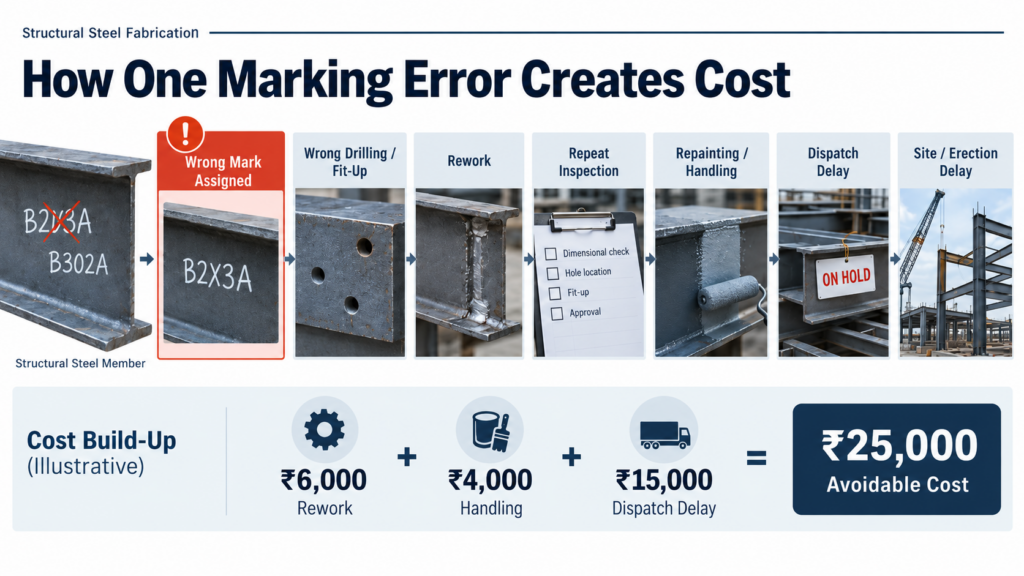
How Can a Mark-Number Error Cost Thousands?
The cost of a marking mistake is rarely the paint or label used to identify the steel.
The real cost comes from everything that happens after the wrong identification.
Consider a simple fictional example.
A beam is mistakenly identified as B42 instead of B47. The error remains unnoticed during drilling and fit-up.
The shop may now face:
- labour required to inspect and identify the problem
- removal or correction of incorrectly fitted components
- additional cutting, drilling, or welding
- repeat dimensional inspection
- repeat blasting or painting
- crane and material-handling time
- changes to packing and dispatch
- possible replacement fabrication
- transport rescheduling
- erection crew waiting at site
Even if each individual activity costs only a few thousand rupees, the combined impact can quickly become significant.
For illustration, imagine ₹6,000 in fabrication rework, ₹4,000 in repeat finishing and material handling, and ₹15,000 in site or logistics disruption. A small identification mistake has now created ₹25,000 of avoidable activity.
These figures are illustrative rather than standard industry rates. The actual impact depends on member size, fabrication complexity, labour rates, logistics, project location, and when the mistake is discovered.
More importantly, project delay can cost more than the steel itself.
How Digital Mark-Number Tracking Improves Control
Digitalisation does not change the engineering meaning of the mark number. It makes that identity easier to carry through the shopfloor.
A manufacturing ERP or MES can treat each mark as part of the production information used by operators, supervisors, quality teams, and dispatch.
Instead of asking someone to manually update multiple registers, the production record can connect the mark with its current operational status.
For example:
B42 → Cutting Complete → Drilling Complete → Fit-Up Running → QC Pending → Painting Pending → Not Ready for Dispatch
That is much more useful than simply knowing B42 exists on a drawing.
This is also where broader manufacturing traceability becomes relevant. Depending on project requirements, the record may connect the mark with material, heat information, production stages, quality checks, rework, and dispatch history.
Where Mobile Scanning and Digital Job Cards Fit
Human-readable marks should remain available where the fabrication procedure requires them. QR codes or barcodes do not need to replace physical piece marks.
Instead, scanning can provide a faster digital reference to the same production identity.
An operator could scan the tag associated with B42 and see the relevant job information rather than searching through a stack of printed documents.
The same scan can support production reporting such as:
- operation started
- operation completed
- quantity processed
- rejection recorded
- inspection required
- component moved to the next stage
The principle behind barcode-based production entry is particularly relevant in fabrication environments where workers deal with many physical components across multiple production stages.
What Effective Mark-Number Control Looks Like
Good mark-number control means the identity of a steel member remains clear throughout the fabrication process.
At any stage, the production team should be able to confirm the correct mark number, the applicable drawing revision, and the current status of the member without checking multiple disconnected records.
For example, if a supervisor checks Mark B42, it should be clear whether the member is still under fabrication, waiting for inspection, being painted, or ready for dispatch.
Where material traceability is required, the same record should also connect the member with the relevant heat and material information.
Quality status should remain linked to the same mark as well. If B42 has passed inspection, requires rework, or is on hold, the team should be able to see that immediately.
By the time the member reaches dispatch, production and dispatch teams should know whether it is complete and ready to ship without manually reconciling multiple spreadsheets or registers.
This is the difference between simply marking a steel member and maintaining control of it throughout fabrication.
How ManufApp Fits Into Structural Steel Shopfloor Control
For structural steel fabricators, ManufApp can support digital job tracking, shopfloor production reporting, quality status, WIP visibility, and barcode or QR-based production entry.
The objective is not to replace structural drawings or engineering practices. Those remain the source of fabrication requirements.
The role of a digital production system is to connect the mark number used in drawings with what is actually happening on the shopfloor.
For example, teams can track whether a member is under fabrication, waiting for quality inspection, held for rework, or ready for dispatch against the same production identity.
This reduces the dependence on separate registers and spreadsheets and gives production, quality, and dispatch teams a more consistent view of shopfloor progress.
From Mark Numbers to Connected Fabrication Control
A mark number starts as an identifier, but its real value appears when that identity remains connected throughout the fabrication process.
The same mark may need to remain connected across:
Drawing → Material → Cutting → Fabrication → Quality → Painting → Packing → Dispatch → Erection
If that connection breaks at any stage, teams can lose visibility. A component may physically exist in the shop but still be difficult to locate, verify, inspect, or dispatch with confidence.
For smaller fabrication jobs, experienced supervisors may manage this through drawings, registers, and manual coordination. As project volumes increase, however, hundreds or thousands of members can move through different workstations at the same time.
At that scale, the challenge is no longer simply assigning mark numbers. It is maintaining a reliable connection between each mark, its fabrication status, quality status, and readiness for the next operation.
Mark-level tracking therefore becomes the foundation for broader shopfloor control, giving production, quality, and dispatch teams a common view of how fabrication is progressing.
Frequently Asked Questions
Is a mark number the same as a heat number?
No. A mark number identifies a fabricated member or group of identical members, while a heat number identifies the steelmaking heat and supports material traceability. The two can be linked where project traceability requires it.
Can identical steel members have the same piece mark?
Yes, depending on the project’s detailing and traceability approach. Completely identical components may share the same piece mark, with quantity used to distinguish how many pieces are required.
Is a piece mark the same as an erection mark?
The terminology can vary between projects and fabrication practices. Piece marks identify fabricated members, while erection marks are used to help identify and position members during erection. In some workflows, the same or related identification may serve both purposes.
Should QR codes replace painted mark numbers?
Not necessarily. A QR code or barcode can provide fast access to the digital production record, while a durable human-readable mark remains useful for visual identification and may be required by the project’s fabrication procedure.
Why track mark numbers digitally if they already exist on drawings?
Drawings tell the team what must be fabricated. Digital production tracking shows what has actually happened: which operation is complete, which member is under inspection, which piece requires rework, and what is ready for dispatch.