


Customer Profile
A global exporter of precision industrial tools was running a complex, high-mix manufacturing setup that involved:
- CNC and VMC machining centers
- Laser cutting
- Shot blasting
- Surface treatment
- Assembly operations
They handled thousands of SKUs, frequent design tweaks, and strict export schedules. In short, they needed accuracy, predictable timelines, and full production traceability.
The Challenge
Here’s where the problem started — they were relying on SAP and Tally for planning and accounting, but nothing was controlling the shop floor. And in a high-mix environment, that gap becomes expensive fast.
1. Zero Real-Time Visibility
Supervisors couldn’t see which jobs were running, which machines were idle, or how operators were performing.
So most decisions were based on guesswork rather than data.
2. Scheduling That Couldn’t Keep Up
Thousands of SKUs moving across machining, blasting, and assembly meant manual scheduling was always one step behind.
Idle machines on one end and long queues on the other became normal.
3. Material Getting Lost Between Processes
Material often got stuck somewhere between CNC → blasting → assembly.
Planning assumed shortages even when stock existed physically.
4. Scrap Without Traceability
Scrap reporting was late and incomplete.
No operator linkage. No machine trace. No reason codes.
Naturally, inventory valuation took a hit.
5. Missed Delivery Commitments
Without a consolidated view of WIP, planning couldn’t commit reliable delivery dates.
Export customers felt the delays.
ManufApp MES + Oracle NetSuite: The Integrated Solution
The manufacturer kept NetSuite for accounting, financials, and inventory valuation.
ManufApp MES handled everything related to execution and shop-floor control.
This split worked beautifully because both systems did what they were best at.
1. Full Shop-Floor Digitization
ManufApp connected all major production stages:
CNC → VMC → Laser → Blasting → Surface Treatment → Assembly
Real-time dashboards showed:
- Running jobs
- Idle or breakdown machines
- Job completion progress
- Operator performance
- Cycle time deviations
What this really meant was simple: supervisors finally knew exactly what was happening on the floor.
2. Intelligent Machine Scheduling
ManufApp’s scheduler used real machine capacity, routing, priorities, due dates, and WIP status to create an optimized plan.
The outcome:
- Manual planning time dropped by 70–80%
- Idle time reduced
- Workload balanced across CNCs, VMCs, and assembly lines
Every machine now had a clear queue.
3. Automated Work Order Creation
Sales Orders from NetSuite flowed into ManufApp.
From there, the system created Work Orders based on:
- BOM structures
- Routing
- Operation sequence
- Machine allocation
NetSuite didn’t need to manage production anymore.
ManufApp ran the shop floor; NetSuite stayed in the financial system of record.
4. Live Material Transfers & WIP Tracking
Operators updated every movement from mobiles/tablets:
- Issue of raw material
- Partial or full completions
- WIP transfers
- Rework
- Consumption
Supervisors instantly saw:
- Where each job was
- Which machine was overloaded
- Which stage was delayed
- What material was pending
It removed the daily “hunt for parts” issue overnight.
5. Scrap Capture With Full Traceability
Scrap was logged at the source with:
- Quantity
- Reason code
- Operator
- Machine
- Timestamp
The insights helped teams find:
- Scrap-heavy machines
- Programming errors
- Tooling issues
- Vendor-specific material defects
And for the first time, NetSuite received accurate costing data.
6. Inventory Accuracy & Perfect Accounting Sync
This is where the integration really shined.
From ManufApp → NetSuite
Only transactions that impacted financial books were pushed:
- Raw material issue to production
- Inventory adjustments
- Assembly builds
- Item fulfillment
- Invoice triggers
- Customer returns → Credit memos
- PO inward → Item Receipt
- Vendor returns
This kept NetSuite’s valuation accurate without overloading it with unnecessary production data.
The result:
Smooth audits. Cleaner ledgers. Zero mismatches.
Impact Delivered
✔ Real-time WIP visibility across 12+ processes
✔ 25–35% better on-time delivery
✔ Higher machine utilization
✔ Accurate inventory records
✔ Fully traceable scrap
✔ Cleaner financial books in NetSuite
Beyond the metrics, the plant stopped firefighting and started running with predictability.
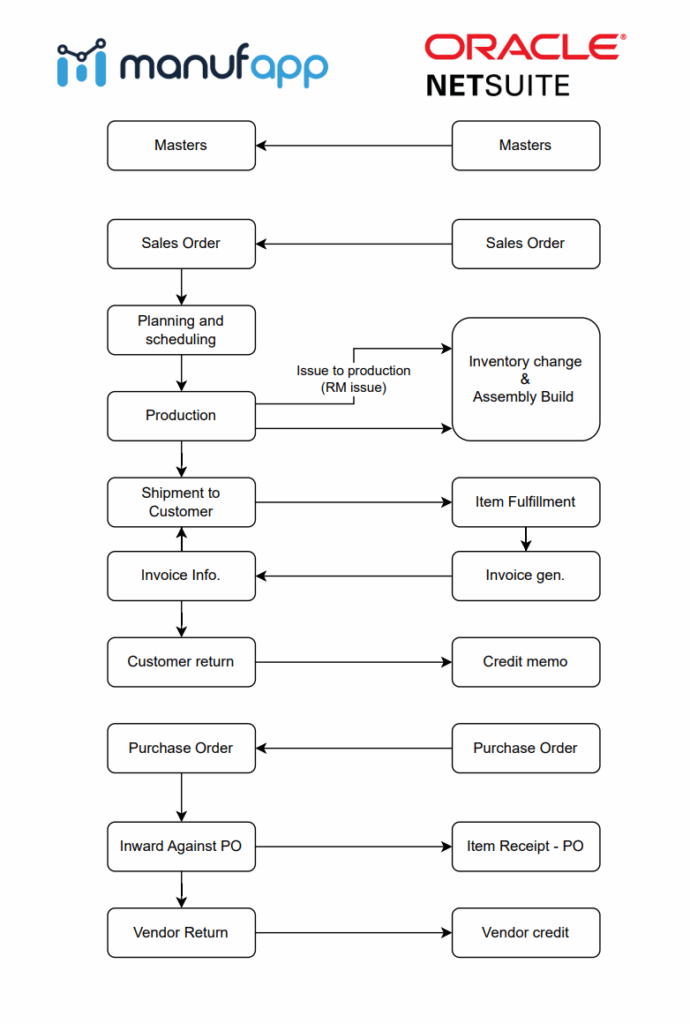
How the Integration Worked (High-Level Flow)
NetSuite → ManufApp
- Sales Orders
- Item masters
- Vendors/Customers
- Purchase Orders
ManufApp → NetSuite
- RM Issue
- Inventory Adjustments
- Assembly Build
- Item Fulfillment
- Credit Notes
- Item Receipts
- Vendor Credits
Functional Flow Diagram
Conclusion
By combining ManufApp’s execution strength with NetSuite’s accounting reliability, the manufacturer finally closed the loop:
- Shop floor digitized
- Production planned realistically
- WIP tracked live
- Scrap controlled
- Financial books accurate
- Delivery commitments met
This integrated MES + ERP approach gave the company the confidence to scale without losing control.


