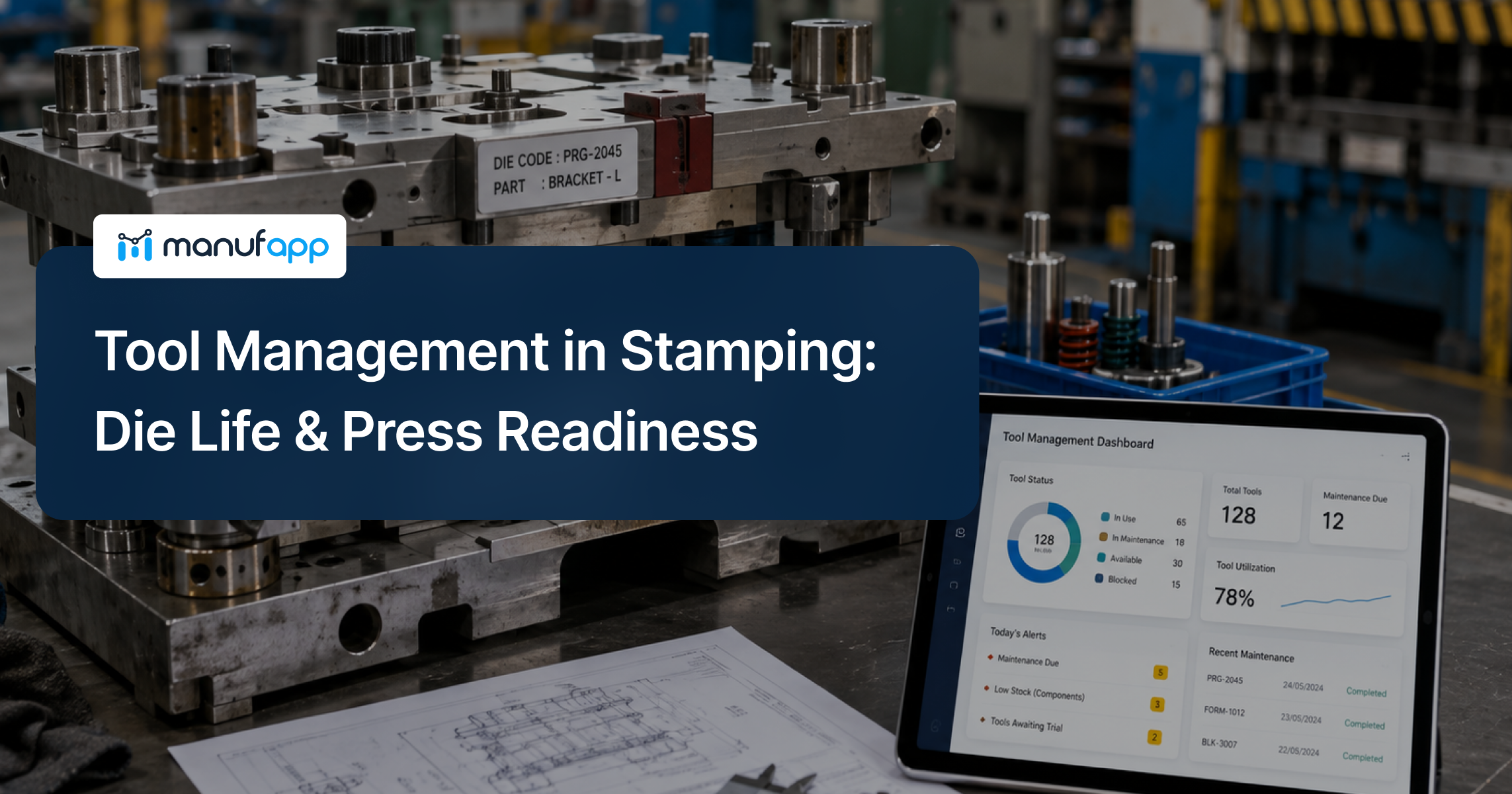


Tool management in stamping becomes critical when a press shop manages hundreds of dies, repeated production runs, multiple presses and tight delivery schedules. A die may look like just another production resource, but its condition directly affects whether the next batch starts on time, whether dimensions stay within tolerance and whether the press keeps running.
The difficulty increases as volumes grow. A tool may finish one production order, move to the tool room for sharpening, wait for a replacement insert and then return for another job. If planning, production and maintenance teams track these events separately, nobody has a reliable view of its actual readiness.
A connected manufacturing system such as ManufApp can help manufacturers treat tooling as part of the production lifecycle rather than as an isolated maintenance record.
What Tool Management in Stamping Actually Covers
Stamping tool management means controlling each production tool from commissioning through usage, maintenance, repair and eventual retirement.
Depending on the plant, the tooling may include progressive dies, compound dies, blanking dies, forming dies, piercing tools, punches, inserts, fixtures and other reusable production assets.
The important point is that a reusable die is different from the material consumed to make the component.
Sheet, coil, fasteners or bought-out parts form part of product material consumption. A stamping die instead enables the operation and remains available for future production runs. This distinction matters when manufacturers configure their masters and production structures. Our guide on why tools and consumables do not belong in a manufacturing BOM explains this separation in more detail.
Good tooling control therefore answers practical questions:
Which die should run this component? Where is it currently located? Can it run on the selected press? How many strokes has it completed? When did the tool room last service it? Is maintenance due? Which components were replaced during the previous repair? Most importantly, can planning safely use it for the next order?
Why Stamping Tool Control Gets Difficult as the Press Shop Grows
A small press shop may manage tooling through experience. The supervisor knows where each die sits and the tool-room technician remembers which tool needs attention.
That approach stops scaling quickly.
A single component may return every week or month. Each production run adds wear to punches, cutting edges, guides, springs, inserts and other elements. At the same time, the die moves between storage, production, inspection and maintenance.
Production volume also matters. A tool that completed 20,000 strokes yesterday does not have the same maintenance condition as an identical tool that remained in storage.
Because of this, calendar-based maintenance alone may not provide enough control. Depending on the tooling and process, manufacturers may schedule maintenance using strokes, production quantity, elapsed time, inspection findings or actual condition.
Quality adds another dimension. An increase in burr, dimensional variation, surface marks or other recurring defects may indicate developing tooling problems. If quality records remain disconnected from tool history, teams lose an important signal.
Planning then faces a simple but expensive question: Is the tool actually ready for the job we are about to schedule?
The Stamping Tool Lifecycle a Manufacturer Should Control
Effective tool management follows the die throughout its working life.
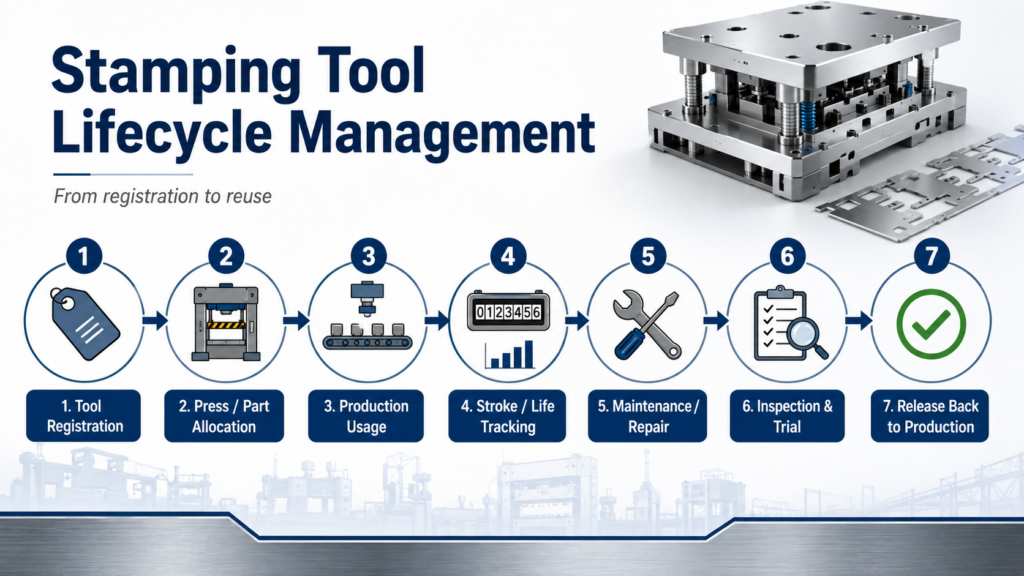
Create a Complete Tool Master
Every important tool needs a unique identity.
The master should capture practical information such as tool code, description, tool type, associated components or operations, compatible presses, location, manufacturer, commissioning details and relevant technical documents.
Manufacturers can also maintain expected life and service intervals where they have reliable standards.
This creates one reference point instead of spreading information across drawings, Excel files, registers and individual employees.
Confirm Tool Readiness Before Production
Production planning should consider more than press capacity.
Imagine that Press P-04 has free capacity tomorrow, but the required die is under repair. A machine-only plan will still show tomorrow as available even though production cannot start.
Tool readiness needs to sit alongside material readiness and machine availability.
This becomes particularly important for high-mix sheet metal units where several parts compete for the same presses and tooling. The same principle applies when building a more reliable production schedule for automotive sheet metal manufacturing.
A planner should ideally know whether a tool is available, in production, under maintenance, awaiting trial, blocked or retired before committing the job.
Capture Actual Tool Usage
Once production starts, the tool accumulates usage.
For stamping dies, manufacturers often use stroke counts or production quantities as practical measures of use. The correct measure depends on the tool design and process.
The objective is not to collect another number for a report. Usage should help the tool room understand how far a tool has progressed towards its next inspection, sharpening or maintenance requirement.
Without actual usage history, maintenance teams often rely on memory or service dates. A heavily used tool and an idle tool can then receive the same treatment even though their operating conditions differ significantly.
Manage Maintenance, Sharpening and Repair History
Tool maintenance should create a history, not simply close a task.
When technicians service a die, they may inspect cutting edges, check alignment, clean the assembly, sharpen punches, replace worn elements or address damage identified during production.
The record should explain what happened, why the team performed the work and what they changed.
Over time, this history becomes valuable. If the same component fails repeatedly, engineering and maintenance teams can see the pattern instead of treating every repair as an isolated incident.
Manufacturers building this discipline can apply the same principles used in a structured preventive maintenance program, while adapting intervals and checklists to tooling.
Release, Block or Retire the Tool
Finishing maintenance does not automatically mean that a tool should return to production.
Some tools need inspection or trial before release. Others may remain blocked until a component arrives or engineering approves a correction.
Simple statuses can prevent confusion:
Available → Issued/In Use → Maintenance Due → Under Maintenance → Trial/Validation → Available
A damaged or end-of-life tool can move to Blocked or Retired instead.
The exact statuses may vary by factory. What matters is that production and planning teams see the same current condition.
Where Excel and Manual Tool Registers Start Breaking Down
Excel can maintain a die list. A physical register can record repair dates. Neither automatically creates a connected operating process.
Problems usually appear between transactions.
A technician takes a die for repair, but nobody updates the planning sheet. Production finishes an additional batch, but the tool-room file still shows the old usage. A punch gets replaced, but the change remains in a technician’s notebook. Another shift searches for the tool because its physical location changed without an update.
Individually, these look like small administrative gaps. Together, they create uncertain schedules, emergency maintenance and lost production time.
Version control creates another problem. Once different departments maintain separate copies, people stop knowing which file represents the current state.
The objective of digital tool management is therefore not simply to replace Excel with a screen. It should connect the events that already happen across the press shop.
What Data Should a Stamping Plant Track for Each Tool?
Manufacturers do not need dozens of fields simply because software allows them.
Start with information that supports a production or maintenance decision.
A practical tool record may include:
- Tool code and description
- Tool type and current status
- Part, operation or process linkage
- Compatible machine or press
- Storage or current location
- Expected tool life where defined
- Current usage or stroke count
- Maintenance interval
- Last and next maintenance requirement
- Breakdown and repair history
- Regrinding or sharpening history
- Replaceable components and critical spares
- Drawings, photographs or instructions
- Quality issues connected with the tool
- Tool ownership or customer ownership where relevant
Manufacturers should also retain movement and service history when traceability matters.
This creates a tooling record similar to an asset history card. For broader manufacturing genealogy and audit requirements, the same approach supports stronger traceability across manufacturing operations.
How ERP/MES Connects Tool Management with Production
Tool management creates more value when the factory connects it with daily execution instead of operating it as a separate database.
Planning Can Check Tool Availability
A planner may have material and machine capacity but still lack a production-ready die.
Connecting tooling with the relevant product, operation or work centre exposes this constraint earlier. Teams can then reschedule the order, finish maintenance first or use another approved tool where the process permits it.
Production Creates Real Usage History
Production reporting provides the actual quantities that ran through the tool.
When the process allows it, the system can use this information to update tool usage instead of asking the tool room to calculate it later from multiple production reports.
This keeps the tooling record closer to shop-floor reality.
Quality Gives Early Warning Signals
Quality and tooling often influence each other.
If rejection increases whenever a particular die runs, teams should be able to investigate the tool’s usage, maintenance and repair history along with production conditions.
The goal is not to assume every defect comes from the die. It is to give engineers enough context to investigate patterns quickly.
Maintenance Protects Future Production Capacity
A maintenance-due tool represents a future capacity constraint.
If the next large order requires that die, planners need visibility before the production date arrives.
The same applies to critical wear parts. A maintenance plan has limited value if the tool room opens the die and discovers that the required insert, spring or punch is unavailable.
Connecting tool maintenance with spare availability helps teams prepare critical components before maintenance begins.
KPIs That Make Tool Management Useful
Manufacturers should avoid building dashboards filled with metrics that nobody acts on. A small set of operational KPIs usually provides more value.
Tool Availability
Shows whether production-critical tooling is ready when planning needs it.
Usage Against Expected Tool Life
Compares actual usage with defined service or life limits. This metric helps teams identify tools approaching attention points.
Preventive Maintenance Compliance
Tracks whether planned tool maintenance happens when required.
Tool-Related Downtime
Shows how much production time the plant loses because of unavailable, damaged or failed tooling.
Repair Turnaround Time
Measures how quickly the tool room restores a tool after it enters repair.
Tool-Related Rejection
Links recurring quality losses with the relevant tool so engineers can investigate wear and repeat failures.
Teams can combine these measures with broader maintenance KPIs for manufacturing rather than creating an isolated reporting system.
How ManufApp Supports Structured Stamping Tool Control
A manufacturing ERP/MES approach can connect tool identity, usage, production context, maintenance and history so that different teams work with the same operational information.
For a stamping plant, the real objective is not another software module. Planning needs to know whether the tool is ready. Production needs the right tool at the right press. Maintenance needs usage and service history. Quality needs context when defects recur. Management needs to understand which tools repeatedly interrupt production.
When those records connect, the factory can manage the tool as a production asset throughout its lifecycle.
Building a More Reliable Tooling Process in Stamping
Tool management in stamping works best when the plant moves beyond a static die list and starts controlling actual tool readiness.
Track where the tool is, what it runs, how much it has worked, what maintenance it needs, which repairs it has undergone and whether production can safely schedule it again.
That discipline helps press shops make better decisions across planning, production, quality and maintenance without depending on memory or scattered spreadsheets.
For manufacturers that want to connect this tooling lifecycle with wider shop-floor operations, ManufApp provides a practical path towards bringing production and tool information into one manufacturing workflow.