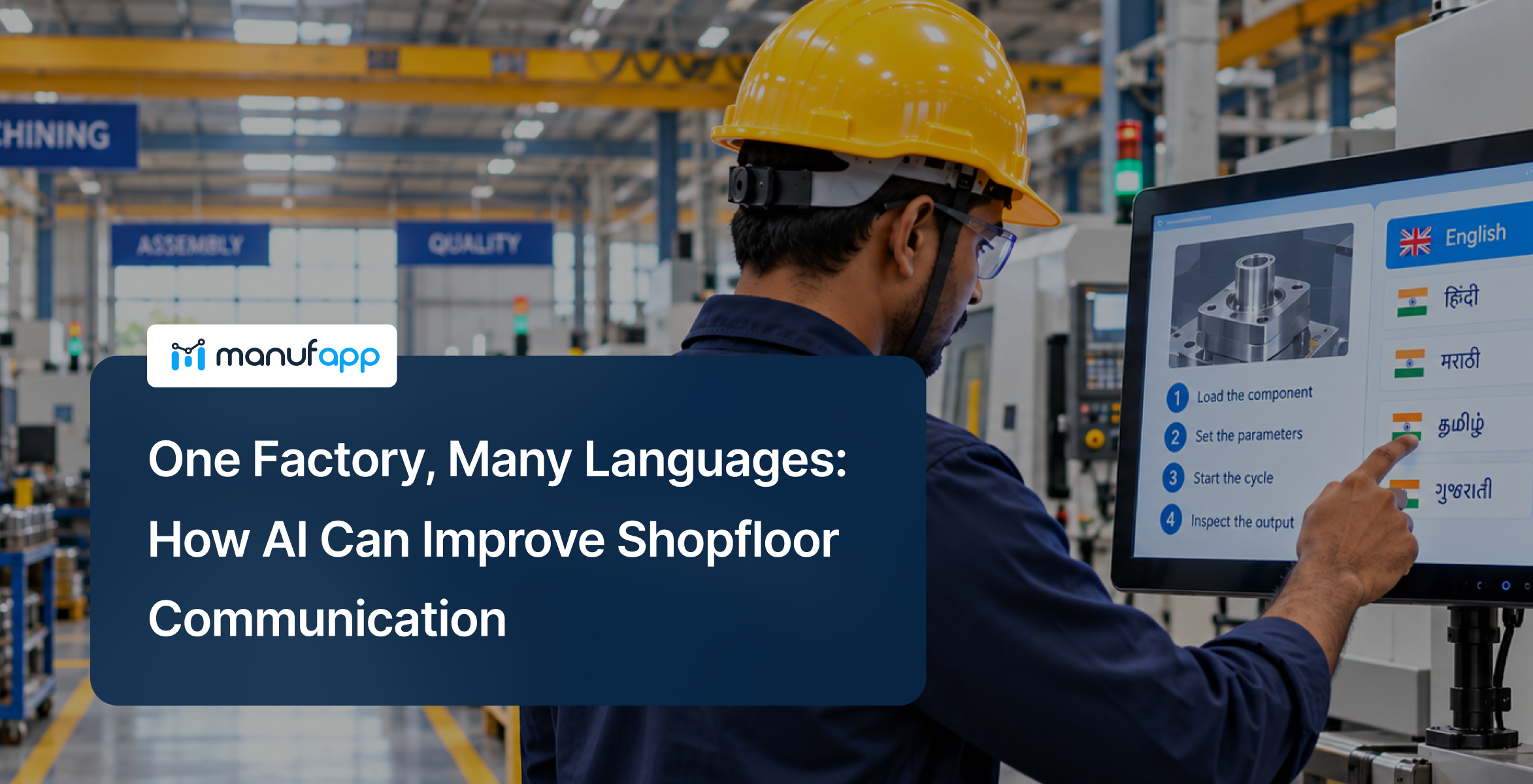


Walk into almost any large manufacturing plant in India and you will hear more than one language being spoken.
The production head may work in English. A line supervisor may explain the job in Hindi. Operators may be more comfortable in Marathi, Tamil, Gujarati, Bengali, Telugu, Punjabi, or another regional language. A machine manual may have come from Germany, Japan, China, or Italy. Meanwhile, the quality team may use technical terminology that operators understand only after someone explains it.
None of this is unusual.
The problem starts when important manufacturing information depends on one person translating, interpreting, or explaining it to another.
A work instruction may be written correctly, but that does not automatically mean everyone on the shopfloor understands it in the same way. A quality requirement may look clear on paper, but the operator may still need a supervisor to explain what actually needs to be checked. A maintenance technician may receive a message saying only that the machine is making a strange sound because the operator is not comfortable describing the issue in the language used by the system.
In multilingual manufacturing, this gap is not simply about language. It directly affects how instructions are understood, how problems are reported, how knowledge is transferred, and how consistently the factory operates.
Technology can help here, but the objective should not be to translate every conversation. The real goal is much simpler: make the right manufacturing information easier for every person to understand and use.
AI can support this by helping workers access instructions, report issues, and understand factory information in the language they are most comfortable using.
One Process Can Sound Very Different Across the Shopfloor
Manufacturing processes are supposed to be standard.
The same job should follow the same route. The same quality parameter should be checked in the same way. The same machine setup should use the same approved values. But the way that process is communicated often changes from person to person.
Consider a new operator joining a machining line. The official work instruction is in English. The supervisor explains it in Hindi. Another experienced operator adds a few practical points from experience. By the end of the week, the new operator may be following a process that is slightly different from the written instruction.
Nothing necessarily goes wrong immediately.
That is exactly why the issue can remain hidden.
Over time, these small interpretation gaps can create different working methods across shifts, machines, and locations.
The same problem appears in quality, maintenance, stores, production reporting, and training. Manufacturers often spend a great deal of effort standardising processes, but much less effort standardising how those processes are understood.
Where the Communication Gap Usually Appears
| Factory Situation | What Usually Happens | Better Digital Approach |
|---|---|---|
| Work instructions | Supervisor verbally explains an English SOP | Show approved instructions in the operator’s preferred language |
| Quality checks | Operators depend on verbal clarification | Display the parameter, tolerance, and inspection stage clearly |
| Breakdown reporting | Short messages like “machine not working” | Capture clearer voice or text descriptions with machine context |
| Operator training | New workers depend heavily on senior operators | Provide accessible digital instructions and approved process knowledge |
| Shift handover | Important details are shared verbally | Record machine, job, quality, and maintenance status digitally |
The Work Instruction Says One Thing. The Operator Understands Another.
Work instructions are one of the most obvious places where language becomes important.
A process document may include the correct sequence, machine setting, inspection requirement, safety note, and handling instruction. However, if the operator cannot comfortably understand the document, the company still depends on verbal explanation.
This creates two problems.
First, the operator may miss something important. Second, the factory becomes dependent on the supervisor or senior operator who knows how to explain the job.
A better approach is to make the instruction easier to consume at the point of work.
Instead of handing an operator a long document, the relevant job information can be shown digitally against the actual production job. The operator can see the process step, images, parameters, checkpoints, and instructions in a language that is easier to understand.
The manufacturing process remains the same. Only the way the information is presented changes. This becomes even more useful when factories already use digital jobcards. A jobcard should not only tell the operator what quantity to produce. It can also become the place where the operator understands the next operation, instructions, quality requirements, and process status.
The role of digital jobcards and mobile scanning therefore goes beyond production entry. They can bring important information closer to the actual work instead of leaving it inside folders, PDFs, or office systems.
Quality Terms Cannot Be Left Open to Interpretation
Quality is another area where language differences can create hidden problems.
Words such as reject, rework, hold, deviation, dent, scratch, crack, burr, contamination, surface finish, and tolerance may sound straightforward to a quality engineer.
For an operator, the meaning may depend entirely on how that requirement was explained during training.
Imagine an inspection instruction saying that a particular dimension must be checked after machining.
If the operator misunderstands the stage at which the measurement should be taken, the entered value may still look correct inside the system. The number is present, but the inspection was done at the wrong point in the process.
The problem is therefore not missing data.
It is misunderstood data.
This is one reason quality problems can continue even after an ERP system is in place. Software can create a place to capture information, but people still need to understand exactly what must be checked and when.
Clearer instructions in the language an operator understands can reduce that gap. The terminology itself should still remain controlled. Factories should not create five different names for the same defect simply because employees use different languages.
There should be one approved meaning. The explanation around it can change. That makes communication easier without losing standardisation.
Breakdown Reporting Is Only Useful If the Technician Understands the Problem
Maintenance teams face a similar issue.
A machine stops and the operator reports:
“Machine not working.”
Technically, the issue has been reported.
Operationally, the maintenance team still knows almost nothing.
Was there an electrical trip? Was the machine making an abnormal noise? Did the motor stop? Was there excessive vibration? Did the cycle stop midway? Was a sensor giving an error? Did the issue begin after a changeover?
The more clearly the operator can describe the problem, the faster the maintenance team can start investigating it.
Language often affects the quality of that description. Many operators can explain the issue perfectly when speaking naturally but struggle when asked to type the same explanation in English into a maintenance form.
Voice input can make this easier.
An operator might say in their preferred language that the machine starts vibrating from one side whenever the speed increases. The system can help turn that observation into a clearer maintenance note, while the operator still confirms what is being submitted.
The technician still diagnoses the machine. The difference is that useful information is less likely to disappear simply because the operator was uncomfortable typing it.
Training Should Not Depend on Who Is Available to Explain the Job
Most factories have people who become unofficial knowledge centres.
When something goes wrong, everyone calls the same person.
When a new operator joins, the same senior employee explains the machine.
When a quality issue occurs, someone says, “Ask him, he knows this item.”
These people are valuable, but too much dependency on them creates a risk.
It becomes even harder when knowledge needs to move between employees who speak different languages. The senior operator may know exactly how a machine behaves before a recurring defect appears. However, that knowledge may never enter the formal SOP because it is easier to explain verbally.
As a result, the factory has documentation and it has experience, but the two are not always connected.
This is closely related to the problem of tribal knowledge in manufacturing.
A better knowledge system should make approved factory experience easier to find. A new technician should be able to search for a recurring issue. An operator should be able to understand why a particular setup step matters. A supervisor should not need to repeat the same explanation ten times every week.
This does not replace experienced people. It allows their useful knowledge to travel further.
Shift Handover Is Another Place Where Information Gets Lost
Factories operate continuously, but people do not.
Every shift change creates a handover.
One operator tells another that a machine was giving a minor issue. A supervisor mentions that a material lot should not be used until quality clears it. Maintenance says one component should be observed during the next shift. Production explains that a priority order must be completed first.
Some of this information is written down.
Some is sent through messages.
Some remains verbal.
Now add a language difference between the outgoing and incoming teams. A small misunderstanding can affect the next several hours of production.
Digital handovers can make this more structured. The important part is not creating another long form. It is making sure the next person clearly understands the machine issue, job status, material problem, quality hold, priority order, or pending maintenance action.
Clear information matters more than long notes.
Translation Is Only the First Step
This is where discussions about multilingual technology often become too simple.
Translation is useful, but manufacturing needs context.
If an operator asks:
“Can I use this material?”
Translating that sentence into English does not solve anything.
The system needs to know which production order the operator is working on, which item is required, whether the material belongs to the correct BOM, which lot is available, whether it has passed inspection, where it is stored, and whether there are expiry or traceability requirements.
The same applies to questions such as:
“Which job should I run next?”
“Why was this batch rejected?”
“Has maintenance completed this machine?”
“What should I check after this operation?”
These are manufacturing questions.
Language simply determines how easily the user can ask them. That is why multilingual communication becomes much more valuable when it is connected with actual ERP and MES information rather than being used as a separate translation layer.
Translation vs Manufacturing Context
| Simple Translation | Context-Aware Manufacturing Information |
|---|---|
| Translates “Can I use this material?” | Checks the production order, BOM, lot, and material status |
| Translates “What should I check?” | Shows the required quality parameter and tolerance for that operation |
| Translates “Machine has a problem” | Links the issue to the machine, job, and maintenance context |
| Translates “What job is next?” | Uses the current production plan and work-centre status |
| Converts words between languages | Connects the question with actual shopfloor data |
Better Shopfloor Communication Should Feel Simple
The best multilingual factory system would not make operators think about the technology behind it.
An operator should simply be able to understand the job.
They should be able to open a jobcard and see what needs to be produced, which operation is next, what quality check is required, and what important instruction applies to the job.
If they have a problem, they should be able to report it naturally.
If they need help, they should be able to find approved information without searching through folders and old messages.
The underlying system can still remain structured.
Item codes remain item codes. Production orders remain production orders. Quality parameters remain controlled. Approval rules do not change. What changes is the effort required for a person to understand the information.
This is where practical AI use cases in manufacturing can become useful. The technology should sit behind the workflow rather than becoming another complicated layer that operators need to learn.
Connect Communication With Actual Production Data
Better communication has another benefit: it can improve the quality of shopfloor data.
When an operator clearly understands a downtime reason, the correct reason is more likely to be selected. When a quality requirement is easier to understand, the inspection record becomes more meaningful.
When maintenance receives a clearer description, technicians spend less time trying to understand what happened before starting the investigation. When shift information is captured properly, supervisors are less dependent on calls and verbal updates.
Over time, this creates better operational visibility.
That matters because many production losses do not begin with a major machine failure. They begin with small gaps between planning, shopfloor execution, reporting, quality, and dispatch. A connected approach to production operations management can help manufacturers see these gaps more clearly.
What Changes on a More Connected Multilingual Shopfloor
| Area | Traditional Approach | More Connected Approach |
|---|---|---|
| Work Instructions | Printed SOPs and verbal explanations | Digital instructions linked to the job |
| Production Reporting | Manual entries after production | Updates captured closer to actual execution |
| Quality | Separate documents and verbal clarification | Inspection requirements shown with the operation |
| Maintenance | Calls and short breakdown messages | Structured machine-specific issue reporting |
| Training | Depends heavily on experienced operators | Approved knowledge available digitally |
| Shift Handover | Verbal notes and messages | Job, machine, and issue status available in one place |
How ManufApp Can Help Build a More Connected Shopfloor
Language support becomes much more useful when it sits inside the system people already use to run production.
ManufApp brings areas such as production, inventory, quality, maintenance, jobcards, and shopfloor reporting into a connected manufacturing environment.
This creates an opportunity to make factory information easier to access for different users without changing the underlying manufacturing process.
An operator should not need to understand complicated software terminology just to know which job comes next.
A maintenance user should not have to type a perfect technical description before reporting a breakdown.
A quality operator should be able to clearly understand which parameter must be checked and at what stage.
A production supervisor should be able to see what is happening without depending on several calls and verbal updates.
The production order already provides context. The jobcard identifies the operation. The material transaction identifies the item and lot. The maintenance record identifies the machine. The quality record identifies the parameter.
Once that context exists, the system can make the information easier for different users to understand and report. That is more useful than simply adding a generic chatbot to a factory. The value comes from connecting communication with actual manufacturing activity.
One Factory Process, Understood by Everyone
A factory does not need a different operating process for every language spoken on the shopfloor.
It needs one controlled process that every relevant employee can understand.
The production route should remain the same. The quality standard should remain the same. The maintenance workflow should remain the same. Approval rules should remain the same.
What should become easier is the way people interact with those processes.
When a work instruction is easier to understand, the operator depends less on verbal interpretation.
When a breakdown is easier to explain, maintenance receives better information.
When quality terminology is clearer, inspection becomes more consistent.
When factory knowledge becomes easier to search, experience is less likely to remain trapped with one person.
That is the real opportunity in multilingual manufacturing.
It is not about translating every sentence spoken inside a factory. It is about making sure the right person understands the right manufacturing information at the moment they need it.