

An industrial machine can be almost complete and still be weeks away from dispatch. The frame is fabricated, most machined components are ready, and electrical wiring is nearing completion. However, a critical motor has not arrived, a shaft needs rework, and the assembly team cannot proceed until these issues are resolved. Despite significant production progress, the manufacturer is still uncertain about the final delivery date.
Such situations are common in industrial machinery and equipment manufacturing. Unlike repetitive manufacturing, machine building involves several activities running simultaneously. Components are manufactured in-house, specialised parts come from external vendors, and different teams prepare assemblies before everything comes together. Even when individual departments meet their targets, the complete machine may fall behind schedule.
Managing these dependencies becomes increasingly difficult as customer orders and machine configurations grow. ERP for Machine Builders connects material requirements, production planning, shopfloor activities, and delivery commitments. It helps manufacturers understand the progress of each order and identify problems that could delay the finished equipment.
Why Machine Building Is Difficult to Plan
Consider a manufacturer producing five industrial packaging machines for three customers. Two machines follow a standard design, while the remaining three require changes in capacity, dimensions, motor specifications, and automation features. Although the machines look similar, their material requirements and production schedules differ. Some components can be manufactured together, while others need separate machining operations or purchased parts with long lead times.
The planning team must balance these requirements with available machines, workers, and materials. A spreadsheet might show the expected completion date of every machine, but it rarely explains the complete production situation. For instance, fabrication may be finished while the electrical panel is still awaiting components. Without knowing this, the assembly team could schedule work that cannot begin.
Planning becomes more complicated when several orders compete for the same resources. A CNC machine reserved for one project may suddenly be needed for urgent rework on another. Meanwhile, an engineering change could affect materials already purchased or components currently under production. These situations force planners to review priorities and adjust schedules repeatedly.
For companies manufacturing custom or engineer-to-order equipment, planning cannot depend only on quantities and delivery dates. It must consider component readiness, available capacity, and the sequence of manufacturing operations. Otherwise, a schedule may look achievable on paper while critical materials or resources remain unavailable.
When One Missing Component Delays an Entire Machine
An industrial machine may contain hundreds or even thousands of components. These include fabricated structures, machined parts, bearings, motors, electrical panels, pneumatic systems, and purchased assemblies. Each component has its own manufacturing or procurement requirement, making material coordination one of the biggest challenges for machine builders.
Take an automated packaging machine with a mechanical assembly, conveyor system, electrical control panel, and pneumatic arrangement. The mechanical assembly contains shafts, rollers, bearings, and fabricated brackets. Its electrical system requires drives, switches, sensors, and control components. All these parts must come together in the correct quantities before final assembly can progress.
A multi-level Bill of Materials (BOM) connects individual components to their subassemblies and ultimately to the finished machine. It gives planners a clear understanding of what must be manufactured or purchased. However, an accurate BOM does not automatically mean the required material is available.
A manufacturer may have ten motors in inventory, but eight could already be allocated to other orders. If the purchase team considers all ten available, it may underestimate the actual requirement. The problem becomes more serious when critical components have long supplier lead times. A gearbox that takes six weeks to arrive can hold up an entire machine if its shortage becomes visible only during assembly.
Connected material planning helps manufacturers compare BOM requirements with physical stock, allocated quantities, and pending purchase orders. As a result, purchase teams can identify shortages earlier and prioritise components that affect delivery schedules. A structured purchase planning process also helps align procurement decisions with actual production requirements.
Engineering Changes Can Disrupt an Existing Plan
Machine designs do not always remain unchanged after order confirmation. A customer may request a different motor capacity, or the engineering team may modify a bracket after identifying a fitment issue. Such revisions can affect components already purchased, manufactured, or issued to production.
For engineer-to-order manufacturers, maintaining control over approved BOM revisions is essential. Teams need to understand which specifications apply to each machine and whether a change affects ongoing production. Without suitable revision controls, departments may continue working with outdated information, leading to unnecessary rework and material waste.
Keeping Fabrication, Machining, and Assembly in Sync
Once materials are available, machine manufacturing moves through several production departments. A typical project may involve cutting, welding, fabrication, turning, milling, drilling, surface finishing, electrical work, and final assembly. These activities do not always follow a single sequence. While one team fabricates the structure, another prepares the control panel, and machining continues for components required later.
Coordinating these parallel activities becomes difficult when multiple orders share the same work centres. Consider three machines requiring components from one CNC machining centre. The planning team must decide which jobs should run first while considering delivery dates and downstream assembly requirements. A component needed immediately for assembly may deserve higher priority than another required several weeks later.
This is why capacity planning in manufacturing plays an important role in machine-building operations. By comparing planned workloads with available machine hours, manufacturers can identify overloaded work centres and adjust production schedules. Better coordination also reduces situations where one department finishes its work but the next remains unable to proceed.
ManufApp connects production planning with work centre capacity and material availability, helping machinery manufacturers organise manufacturing activities against customer orders. Planning teams can monitor scheduled production, identify capacity constraints, and adjust priorities when requirements change.
However, even a well-prepared schedule has limited value if it does not reflect actual shopfloor progress. Production managers need to know whether operations are complete, delayed, or waiting for material before making further commitments.
Tracking What Is Actually Happening on the Shopfloor
Many machinery manufacturing units still depend on supervisors collecting updates from individual departments. Fabrication may maintain one register, machining another spreadsheet, and assembly a separate progress report. By the time these updates reach the production manager, the actual situation may have changed.
For example, a shaft may appear complete after turning, even though grinding and inspection are still pending. If assembly assumes the component is ready, workers may be assigned to a job that cannot begin. Such gaps between reported progress and actual readiness lead to repeated follow-ups and unnecessary waiting.
Digital job cards connect production records with specific orders, components, and manufacturing processes. Operators can record completed quantities, pending operations, and rejections against the relevant work. Supervisors then have a clearer picture of production progress across departments.
ManufApp supports this approach through digital job cards and work centre-based production tracking. Shopfloor teams can record production activities, while supervisors can review completed operations and work-in-progress. A connected production management system for machinery manufacturers helps reduce dependence on manual status updates.
The Work That Happens Outside Your Factory
Not every component of an industrial machine is manufactured within the same facility. Machinery manufacturers frequently outsource operations such as precision machining, heat treatment, powder coating, plating, and specialised fabrication. These components remain part of the production requirement even while they are physically located at a vendor’s facility.
Consider a machine frame sent for powder coating. The assembly department expects it back on Monday, but the vendor has not completed the process. If planning does not receive this information, workers may be allocated to an assembly operation that cannot begin. The delay could also affect other machines scheduled to use the same assembly area.
Subcontracting management should therefore remain connected to production planning. Manufacturers need visibility into materials sent to vendors, quantities under processing, expected return dates, and actual receipts. When outsourced parts return, inward verification and quality inspection may be necessary before they move to the next stage.
Keeping these transactions connected helps production teams understand the true readiness of components. It also reduces uncertainty when estimating whether an order can move into final assembly.
A Completed Machine Is Not Always Ready to Ship
As components arrive from different departments, the machine enters final assembly. This is often where previously unnoticed problems become visible. A fabricated structure may require adjustment, an electrical component may not match the approved specification, or a machined part may fail during fitment.
These issues can require rework even when individual production operations are already marked complete. Final assembly is therefore more than the last stage of manufacturing. It brings together several components and processes that must function correctly as one machine.
A machine with most of its parts completed may still be far from delivery if a critical assembly remains pending. Tracking progress at the component and assembly levels provides a clearer picture of actual readiness.
Testing, Inspection, and Rework
Before dispatch, industrial machines may undergo dimensional checks, electrical inspections, safety verification, functional testing, and performance trials. Depending on customer requirements, manufacturers may also conduct a Factory Acceptance Test (FAT) to verify that the equipment meets agreed specifications.
When testing identifies a problem, the affected component may require rework, replacement, or further inspection. These activities can influence the delivery schedule, especially if replacement parts have long lead times.
Maintaining production and inspection records helps quality teams investigate problems and identify affected components. For expensive, customised machinery, such records also support future troubleshooting and service activities. Connected manufacturing traceability makes it easier to follow relevant material and production records during quality investigations.
Dispatch Requires More Than Production Completion
Even after successful testing, a machine may not be ready to leave the factory. Large equipment often requires dismantling into transportable assemblies. Electrical panels, accessories, spare parts, and supporting documentation may also need separate packaging.
The dispatch team must verify that the shipment includes everything required under the customer order. Missing accessories or incomplete documentation can delay installation, even when the main machine reaches the customer’s site on time.
For machinery manufacturers, delivery planning should therefore consider the complete equipment package. Production completion, testing approval, packing readiness, and dispatch confirmation represent different milestones that need proper coordination.
Connecting Machinery Manufacturing Operations with ManufApp
The challenges of machine building rarely belong to one department. A material shortage affects planning, a machining delay affects assembly, and a quality rejection can change the delivery schedule. When departments maintain separate records, these problems become difficult to identify until they have already affected production.
A connected manufacturing system allows teams to work with consistent information across orders, inventory, procurement, planning, production, quality, and dispatch. This is particularly useful for manufacturers handling several customer projects with different configurations and delivery commitments.
ManufApp brings these manufacturing activities together so planning teams can monitor production requirements, stores can manage component availability, and shopfloor teams can record operational progress. Quality and dispatch activities remain connected to the wider manufacturing workflow, giving teams a clearer understanding of pending work.
For highly customised machinery, requirements such as engineering revision control, advanced project costing, and customer-specific testing documentation should be evaluated separately. The right system configuration depends on how each manufacturer manages engineering and production.
Choosing ERP That Matches the Way Your Factory Works
Not every machinery manufacturer follows the same production model. A company manufacturing standard agricultural equipment may produce repeatable assemblies in batches. In contrast, a custom automation company may design almost every machine according to customer specifications.
Both require manufacturing control, but their planning methods and operational challenges differ. Before selecting software, manufacturers should examine how it handles multi-level BOMs, order-specific materials, manufacturing routes, subcontracting, and assembly progress.
The evaluation should also consider what happens when production does not follow the original plan. Can planners identify shortages before releasing work? How does the system handle changes in component requirements? Can supervisors track individual operations and identify which pending parts are holding up assembly?
These questions often reveal more than a long list of software features. A useful approach is to evaluate the ERP using an actual customer order, following it from material planning through production, testing, and dispatch.
Frequently Asked Questions
What is ERP for machine builders?
ERP for machine builders is a manufacturing management system that connects customer orders, BOMs, material procurement, production planning, shopfloor activities, assembly, quality, and delivery. It helps industrial machinery manufacturers coordinate the different operations involved in producing equipment.
Can ERP handle custom machine manufacturing?
Yes, provided the system supports the required make-to-order or engineer-to-order workflows. Manufacturers should evaluate how it handles customer-specific BOMs, engineering revisions, material requirements, and production tracking before implementation.
How does ERP improve machinery production planning?
ERP connects production requirements with inventory, purchasing, and available manufacturing capacity. This allows planners to identify material shortages, schedule work across departments, and monitor progress against customer delivery commitments.
Building Machines with Better Production Control
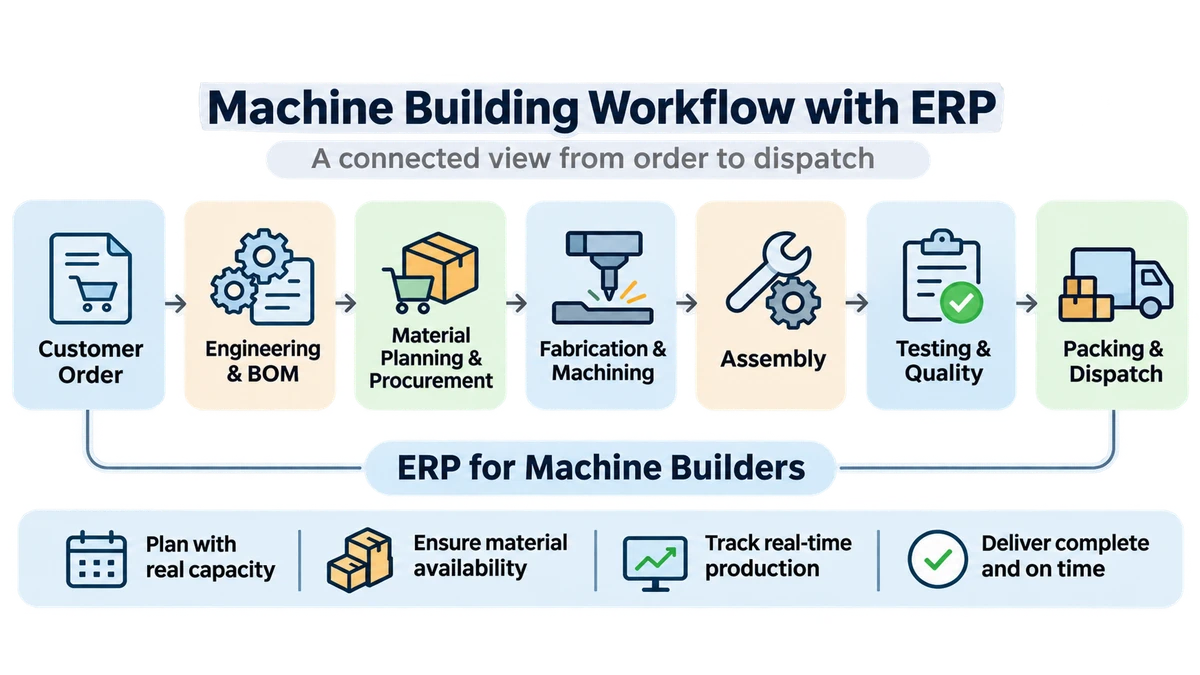
Industrial machinery manufacturing involves much more than completing individual production operations. A customer order can pass through engineering, procurement, fabrication, machining, subcontracting, assembly, and testing before the equipment is ready for delivery. Every stage depends on information and activities from other departments, making coordination important throughout the project.
As machine complexity and order volumes increase, disconnected records make these dependencies harder to manage. A delayed component can affect several downstream activities, while limited visibility may prevent teams from recognising the problem early enough.
ERP for Machine Builders provides a structured approach to connecting manufacturing activities, monitoring production progress, and identifying issues that could affect delivery. For industrial machinery manufacturers, better production control means knowing which components are ready, which operations are pending, and what needs attention to keep each customer order moving.