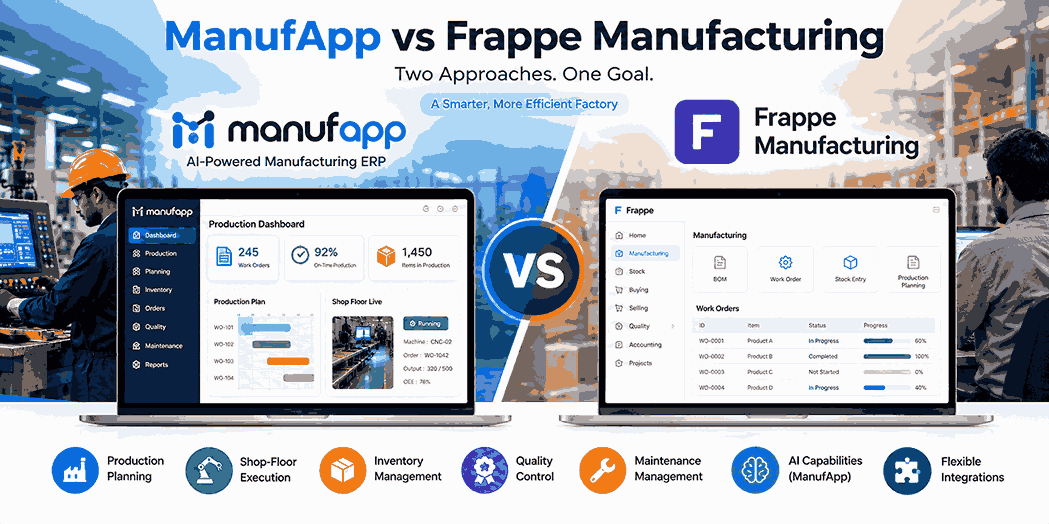


ManufApp vs Frappe Manufacturing is not simply an ERP feature comparison. The better choice depends on how much control you need over planning, production, shop-floor execution, quality, maintenance and integrations. ManufApp combines Manufacturing ERP, MES and manufacturing-focused AI, with implementation experience across 300+ shop floors.
| Decision Area | ManufApp | What to Check in Frappe Manufacturing |
| Manufacturing approach | ERP + MES | Validate against your complete process |
| Production planning | Manufacturing-focused workflow | Test your scheduling complexity |
| Shop-floor execution | Connected with MES | Check required execution depth |
| Quality & maintenance | Dedicated manufacturing modules | Verify your process requirements |
| Manufacturing AI | Maintenance AI, IMS, Document AI | Check practical AI use cases |
| Factory connectivity | PLC, OPC, APIs | Validate machine/system connectivity |
| Business integrations | SAP B1, SAP ECC, Zoho, Tally | Confirm your existing stack |
| Scale | Lite, Pro, Enterprise | Evaluate long-term operational fit |
Most ERP comparisons start in the wrong place.
They begin with modules.
Inventory? Yes.
Purchase? Yes.
Production? Yes.
But your plant manager does not work inside a feature checklist.
Your team deals with late materials, urgent orders, machine downtime, quality holds, changing priorities and dispatch commitments.
So that is where a useful Frappe Manufacturing comparison should begin.
What Should You Really Compare in ManufApp vs Frappe Manufacturing?
Compare how each system behaves when your manufacturing plan meets real factory conditions. A useful evaluation should follow orders from material planning through production, quality and dispatch while testing what happens when conditions change unexpectedly.
Think about one normal Wednesday in your factory.
Sales has promised three orders.
Planning has built today’s schedule.
Stores discovers one raw material shortage.
Machine 6 stops after lunch.
Quality holds part of yesterday’s production.
At 3:30 PM, a customer calls asking whether tomorrow’s dispatch is still possible.
This is the environment your ERP has to support.
Not the demo environment where every machine runs perfectly and every material arrives on time.
Why Is Manufacturing Fit More Important Than Having More ERP Features?
Manufacturing fit means the software follows the way materials, machines, people and information move through your factory. A long feature list has limited value if your team still needs Excel, paper or WhatsApp to complete critical production activities.
Consider production planning.
Your ERP may technically have a planning screen.
But if planners export order data into Excel every morning before creating the actual machine schedule, planning is not truly connected.
The feature exists.
The operational problem still exists.
The same applies to quality, maintenance and shop-floor reporting.
When evaluating Frappe Manufacturing vs ManufApp, ask where your employees will actually perform their work after implementation.
How Does ManufApp Approach Manufacturing Operations?
ManufApp is an AI-powered Manufacturing ERP + MES platform developed by WYNTOK Technologies. It connects planning and enterprise processes with actual production execution rather than treating the shop floor as a separate operating environment.
ManufApp covers 10 core manufacturing areas:
Production
Planning
Inventory
Orders
Purchase
Quality
Maintenance
Subcontracting
Tool Management
Costing
The important part is not having ten module names.
It is what happens between them.
Suppose production consumes material.
Inventory should reflect it.
Suppose quality rejects a batch.
Production should know.
Suppose a machine becomes unavailable.
Maintenance and production planning should not behave like two unrelated departments.
Connected manufacturing is about these relationships.
How Should You Test Production Planning in Frappe Manufacturing vs ManufApp?
Do not test production planning by asking a vendor to create a normal schedule. Ask them to repair a schedule after something goes wrong. That reveals how useful the system will be when planners are under real operational pressure.
Use this example.
You have four work orders planned today.
WO-101 is urgent.
WO-102 needs a component arriving at noon.
WO-103 is already one day late.
WO-104 uses the same machine as WO-101.
Now tell both vendors:
The shared machine has broken down for three hours.
Ask them to show what your planner does next.
Can the system help identify affected orders?
Can another machine or slot be considered?
Can priorities be changed?
Can the production team see the updated plan?
Can management understand the impact on delivery?
This is far more useful than asking:
“Does your ERP have production planning?”
How Does ManufApp Handle Production Planning?
ManufApp’s Planning & Control capabilities are designed around machine-wise scheduling, shifts, production loads and manufacturing priorities. Planning sits alongside Production, Inventory, Maintenance and Orders rather than functioning as an isolated scheduling tool.
That connection becomes useful because the factory plan depends on information from other areas.
You cannot create a reliable schedule without understanding:
Material.
Machine availability.
Customer priority.
Current WIP.
Capacity.
Previous delays.
When those variables exist in different systems, planners spend much of their time collecting information before they can actually plan.
What Should You Compare About Shop-Floor Execution?
Shop-floor execution tells you whether planned production is actually happening. When comparing ManufApp vs Frappe Manufacturing, test how work orders reach production and how actual quantities, progress, delays and completion information return to management.
Imagine management sees this:
Work Order 784 — Scheduled Today
That sounds useful.
Until someone asks:
Has it started?
Which machine is running it?
How many units are finished?
Has production stopped?
Why has it stopped?
Will the order finish today?
If supervisors still need to answer those questions manually, management is seeing the plan—not necessarily the factory.
ManufApp combines Manufacturing ERP with MES capabilities for shop-floor execution and production monitoring.
This is one of the areas you should test carefully during a Frappe Manufacturing comparison.
Why Does ERP + MES Matter for a Manufacturing Company?
ERP decides and coordinates what the business intends to manufacture; MES brings deeper visibility into how that production is actually being executed. Connecting the two reduces the gap between management plans and shop-floor reality.
ERP might contain:
Customer order
BOM
Purchase requirement
Inventory
Production plan
Cost
MES becomes closer to:
Work-order execution
Production progress
Shop-floor data
Machine/process status
Actual production activity
A growing factory can eventually reach a point where ERP visibility alone is not enough.
Your management team knows what was planned.
The missing question becomes:
What is happening right now?
ManufApp is designed around this ERP + MES connection.
How Should BOM and Material Requirements Be Tested?
A manufacturing system should turn product demand into reliable material requirements and make shortages visible before production reaches the machine.
Instead of asking to see a sample BOM, give both systems one of your actual products.
Suppose Product A requires:
1 housing
2 bearings
4 connectors
8 fasteners
You need 500 finished units.
Now ask the system to calculate requirements.
Then introduce reality.
Some bearings are already allocated elsewhere.
Part of the connector stock is awaiting quality approval.
A purchase order is expected tomorrow.
The useful question is no longer:
“How much stock do we have?”
It becomes:
“Can we actually manufacture 500 units on the promised date?”
That is the question your ERP should help answer.
How Should Inventory Be Evaluated in ManufApp vs Frappe Manufacturing?
Manufacturing inventory needs context. A stock balance becomes useful only when the system connects it with production requirements, reservations, consumption, quality status and material movement.
For example:
ERP stock: 2,000 pieces.
Production requirement: 1,300 pieces.
At first, everything looks fine.
But perhaps:
500 pieces are committed elsewhere.
300 are under inspection.
250 have already been issued.
Your actual planning position is very different.
ManufApp’s Inventory Management works alongside production and planning, with capabilities including lot/batch tracking, ageing, stock visibility and material controls.
During your Frappe Manufacturing evaluation, recreate the same situation.
See which workflow your planner understands faster.
How Should You Compare Quality Management?
Quality should be part of production, not a report created after production. A useful manufacturing ERP should connect inspections and rejections with the material, production order, supplier or manufacturing stage involved.
Try this during the demo:
Your factory produces 1,000 pieces.
During in-process inspection, 60 pieces fail an important parameter.
- Where is the rejection recorded?
- Can you identify the relevant production order?
- Can you trace the affected material?
- Can planning understand the reduced output?
- Can the team record corrective action?
- Does finished stock reflect what passed?
ManufApp includes inward quality, in-process checks, CTQ parameters and rejection tracking within its Quality module.
This is a much more meaningful test than asking whether software has a “Quality” menu.
Why Should Maintenance Influence Your ERP Choice?
Maintenance directly affects production capacity, which means machine downtime should not remain invisible to production planning.
Suppose your plan expects Machine 03 to produce 800 parts today.
At 10:40 AM, the machine fails.
The maintenance technician now has one job:
Fix the machine.
But the factory has another problem:
What happens to the 800-part production commitment?
If maintenance and planning operate independently, the machine may remain allocated in the production plan long after it has stopped.
ManufApp combines Maintenance with its broader production environment, including preventive schedules, breakdown handling, downtime analysis, corrective measures and spare-parts management.
What Makes ManufApp’s AI Relevant to a Factory?
ManufApp uses AI around three practical manufacturing areas: maintenance support, visual factory monitoring and document digitisation. The purpose is not to add an AI label to ERP; it is to reduce information and response gaps inside manufacturing operations.
What Does Maintenance AI Do?
Maintenance AI helps technicians access guidance and possible fixes while working on machine problems.
Factories often accumulate maintenance knowledge in manuals, old records and experienced employees.
Making that knowledge easier to use during troubleshooting can be more valuable than another maintenance dashboard.
What Does IMS Do?
IMS, or Intelligent Monitoring System, uses computer vision to monitor manufacturing activity and identify operational events.
This creates another source of shop-floor visibility beyond manual reporting.
What Does Document AI Do?
Document AI converts manufacturing records into usable digital information.
This addresses a practical reality.
Many factories are partly digital.
ERP may be online while inspection sheets, maintenance documents or production records remain on paper.
Document AI helps bridge that gap.
When comparing Frappe Manufacturing vs ManufApp, ask both systems:
“Show me what AI does for an actual factory employee.”
That question is much better than asking whether AI is available.
How Should You Evaluate Integration Requirements?
Your manufacturing software should fit into your technology environment rather than forcing you to replace useful systems unnecessarily.
ManufApp supports integration with:
SAP Business One
SAP ECC
Zoho
Tally
APIs
For shop-floor connectivity, ManufApp can integrate with:
PLC
OPC
Weighing systems
Testing equipment
This matters particularly for manufacturers already using a major ERP.
For example, a company may want to retain SAP for enterprise functions while strengthening production execution.
In that case, replacing SAP may make little sense.
The manufacturing layer should connect with it.
During your ManufApp vs Frappe Manufacturing evaluation, provide both teams with your real system architecture—not an imaginary greenfield setup.
How Should an Indian Manufacturer Think About ERP Implementation?
ERP implementation should be judged by how quickly employees can run their real processes correctly inside the system—not simply whether the software has been installed.
This distinction matters in Indian manufacturing environments.
Operators may have different levels of digital familiarity.
Production cannot stop for weeks while everyone learns a complicated process.
Supervisors need practical workflows.
Management needs reliable data.
Stores needs accurate material movement.
Quality needs usable inspection records.
A successful implementation has to work for all of them.
ManufApp has been implemented across 300+ shop floors in India, giving its product and implementation approach exposure to actual factory operations.
What Should You Ask About Customisation?
Instead of asking:
“Can you customise the ERP?”
“Why do we need this customisation?”
Sometimes customisation is necessary because your manufacturing process is genuinely unique.
But sometimes it exists because a standard workflow has never been properly defined.
Too much customisation can also make upgrades, support and employee training more complicated.
During your Frappe Manufacturing comparison, divide requirements into three categories:
Must-have: Without it, production cannot run correctly.
Useful: It improves efficiency but is not essential at go-live.
Preference: Your team simply likes doing something a particular way.
This prevents an ERP project from becoming a collection of hundreds of small requests.
What Is the Best Way to Test ManufApp vs Frappe Manufacturing?
Run a “bad day in the factory” test.
Most software looks good when everything goes right.
Your ERP earns its value when things go wrong.
Give both systems the same scenario:
A customer order requires 2,500 units.
One material is short.
The supplier postpones delivery.
Production begins with available material.
A machine fails midway.
Quality rejects part of the first batch.
The customer then asks for 1,000 units urgently.
Now ask:
What does the planner see?
What does production see?
What does stores see?
What does maintenance see?
What does quality see?
What completion date does management see?
The stronger system should help those teams work through the problem without creating several disconnected versions of reality.
When Could ManufApp Be the Better Fit?
ManufApp deserves stronger consideration when your requirement goes beyond back-office ERP and extends into shop-floor execution, production visibility, maintenance, quality and manufacturing AI.
It may be particularly relevant when you need:
Manufacturing ERP + MES.
Machine-wise planning.
Real-time production visibility.
Integrated quality.
Integrated maintenance.
AI-assisted maintenance.
Computer-vision monitoring.
Document digitisation.
SAP integration.
PLC or OPC connectivity.
A manufacturing platform designed around Indian factories.
That does not automatically make it the right system for every company.
It makes these capabilities worth testing against your requirements.
What Should You Verify Before Choosing Frappe Manufacturing?
A fair comparison requires the same evaluation standard for both products.
Ask the Frappe Manufacturing team to demonstrate your exact requirements around:
Production planning.
BOM and MRP.
Machine capacity.
Shop-floor execution.
Quality.
Maintenance.
Material traceability.
Subcontracting.
Tools.
Costing.
Machine integration.
Existing ERP integration.
Mobile/shop-floor usage.
AI requirements.
Do not accept a simple “yes, supported.”
“Please show us.”
The difference between available and usable in your factory can be significant.
How Should You Build a Final Decision Scorecard?
Do not let one impressive dashboard decide a five-year software decision.
Create a simple score from 1 to 5 across areas that matter to your plant.
Give greater weight to critical processes.
For example:
Production planning — very high importance
Shop-floor execution — very high
Inventory — high
Quality — high
Maintenance — high
Integration — high
Costing — medium/high
AI — based on your roadmap
Ease of use — very high
Implementation support — very high
Then let actual users participate.
Include:
Plant manager.
Production planner.
Stores representative.
Quality team.
Maintenance team.
Management.
IT.
The ERP that impresses management but frustrates operators can become an expensive reporting system with Excel still running underneath it.
Is ManufApp Better Than Frappe Manufacturing?
ManufApp may be the stronger fit for manufacturers that want an integrated Manufacturing ERP + MES environment with manufacturing AI, shop-floor visibility and factory-system integrations. The final decision should still come from testing both systems against your own manufacturing processes.
ManufApp brings together:
10 core manufacturing modules.
ERP + MES.
Maintenance AI.
IMS.
Document AI.
SAP B1 and SAP ECC integrations.
Zoho and Tally integration.
PLC and OPC connectivity.
300+ shop-floor implementations.
For Frappe Manufacturing, validate your equivalent requirements during the product evaluation.
That creates a fairer decision than relying on claims from either vendor.
What Is the Final Verdict on ManufApp vs Frappe Manufacturing?
Choose based on your factory operating model, not software popularity or the number of available features.
If your biggest problem is that planning and shop-floor reality remain disconnected, put MES and production execution near the top of your scorecard.
If maintenance downtime affects delivery, evaluate maintenance deeply.
If paper records remain everywhere, consider how digitisation will happen.
If SAP must remain in place, integration becomes critical.
If your managers spend half the day asking for production updates, visibility matters more than another reporting screen.
ManufApp’s approach is built around Manufacturing ERP + MES + AI, with the aim of connecting what the business plans with what the factory actually executes.
The best way to decide?
Bring a real order.
Bring a real BOM.
Bring one production problem your team deals with every week.
Then ask both systems to solve it.
That is your real ManufApp vs Frappe Manufacturing comparison.
Compare ManufApp With Your Actual Factory Process
See how ManufApp handles your production planning, inventory, shop-floor execution, quality, maintenance and integrations using your own manufacturing workflow.
Compare ManufApp — Free Assessment
FAQ
What is the difference between ManufApp and Frappe Manufacturing?
ManufApp combines Manufacturing ERP, MES and factory-focused AI in one manufacturing environment. For a useful Frappe Manufacturing comparison, manufacturers should test Frappe against the same production planning, shop-floor, quality, maintenance and integration requirements.
Which is better: Frappe Manufacturing vs ManufApp?
There is no single answer for every factory. ManufApp may be particularly suitable where manufacturers require ERP + MES, shop-floor execution, Maintenance AI, computer-vision monitoring and connectivity with existing enterprise or machine systems.
What should I compare in ManufApp vs Frappe Manufacturing?
Compare BOM and MRP, planning, work-order execution, inventory, quality, maintenance, costing, subcontracting, integrations and employee usability. Test production exceptions as well as the normal manufacturing flow.
Does ManufApp include a Manufacturing Execution System?
Yes. ManufApp combines Manufacturing ERP with MES capabilities so production planning can connect more closely with actual shop-floor execution and manufacturing information.
What AI features does ManufApp provide?
ManufApp provides Maintenance AI, IMS (Intelligent Monitoring System) and Document AI. These capabilities address technician support, computer-vision-based monitoring and digitisation of manufacturing records.
Can ManufApp integrate with SAP?
Yes. ManufApp supports SAP Business One and SAP ECC integrations, along with Zoho, Tally and APIs. Shop-floor connectivity can also include PLC and OPC systems.
Is ManufApp suitable for Indian manufacturing SMEs?
Yes. ManufApp offers Lite, Pro and Enterprise subscription options and has experience across more than 300 shop-floor implementations in India.
How should I conduct a Frappe Manufacturing comparison?
Use the same real manufacturing scenario in both systems. Include material shortages, planning changes, machine downtime and quality rejection so you can judge how each platform performs outside a perfect demo workflow.