

Your factory’s production data may be more valuable than you think. But who controls it when AI enters the picture?
Manufacturers are increasingly exploring artificial intelligence to analyse production performance, investigate quality issues, improve maintenance decisions, and make operational information easier to access.
Yet behind every AI-generated insight is something far more valuable: manufacturing data.
Production schedules, customer specifications, machine parameters, bills of materials, supplier pricing, and inspection records contain information that manufacturers have strong reasons to protect.
As AI becomes more closely connected to manufacturing operations, companies face a difficult question: How much sensitive factory information should AI be allowed to access, and under what conditions?
This is where private AI in manufacturing becomes relevant.
Rather than treating AI adoption as simply another technology upgrade, manufacturers need to consider data ownership, access control, confidentiality, and the security of their existing ERP and MES information.
The challenge is not choosing between AI and data protection. It is finding a way to benefit from both.
Why Manufacturing Data Needs Stronger Protection
Every manufacturing facility generates significant amounts of operational information through everyday activities.
Production reports, inspection records, bills of materials (BOMs), machine parameters, maintenance histories, and inventory transactions may appear to be routine documents.
However, together they reveal how a factory operates, what it produces, and how efficiently it manages its resources.
Consider an automotive component manufacturer producing precision-engineered parts.
Its manufacturing records may contain years of process improvements, machine settings, customer specifications, material consumption patterns, and quality control methods.
Much of this information represents valuable intellectual property developed through operational experience.
If sensitive records are shared without proper safeguards, the consequences can include commercial exposure, contractual concerns, loss of confidentiality, and damage to customer trust.
What Manufacturing Data Needs Protection?
Not every manufacturing record carries the same level of risk. Manufacturers should understand which information requires stronger protection.
| Manufacturing Data | Examples | Potential Risk if Exposed |
| Production Data | Cycle times, production output, process routes | Reveals manufacturing capacity and operational methods |
| Product & Engineering Data | BOMs, drawings, specifications | Exposes proprietary product and process information |
| Quality Data | Inspection results, rejection reports, tolerances | Reveals product quality issues and customer requirements |
| Commercial Data | Customer orders, supplier pricing, quotations | Exposes sensitive business relationships and pricing |
| Maintenance Data | Equipment failures, service records, machine configurations | Reveals equipment vulnerabilities and operational dependencies |
This information becomes especially sensitive when records are connected across departments.
For example, combining production quantities, material costs, customer orders, and capacity information could reveal commercially valuable details about a manufacturer’s operations.
The challenge is to make these records accessible for legitimate AI-assisted analysis without making them accessible to unauthorised users.
The Hidden Risks of Sharing Factory Data with AI
Artificial intelligence becomes more useful when it can access actual manufacturing information.
A general AI assistant can explain the meaning of machine downtime.
But identifying why a particular CNC machine has experienced repeated breakdowns requires access to its actual maintenance records.
Similarly, AI can explain inventory optimisation, but identifying potential material shortages requires current stock information, production plans, and consumption patterns.
This creates three important concerns.
1. Sensitive Information May Leave the Manufacturer’s Control
When employees upload operational records into external AI applications, the information may be processed on infrastructure outside the organisation.
This does not automatically mean the data becomes public or is used to train AI models. These conditions depend on the provider, service agreement, product settings, and data handling policies.
However, manufacturers need to understand exactly how their information will be processed, stored, retained, and protected.
2. Different Teams Require Different Information
A purchase manager may need supplier quotations and material costs, while a production supervisor primarily requires work orders, machine status, and output information.
An AI system connected to manufacturing operations must respect these differences.
Without appropriate access controls, employees could receive information through an AI assistant that they would not normally be authorised to access.
3. Incorrect AI Responses Can Affect Operational Decisions
Imagine an AI assistant informing the dispatch team that a finished goods batch is ready for shipment.
If the AI overlooks a pending quality inspection, the recommendation could create an operational problem.
This is why AI-generated insights must be based on accurate information and remain subject to suitable verification.
For manufacturing operations, reliability and accountability matter just as much as speed.
What Is Private AI in Manufacturing and How Does It Work?
Private AI refers to an approach where an organisation implements artificial intelligence with defined controls over data access, processing, storage, and use.
Instead of allowing employees to share confidential production information through unapproved applications, a controlled private AI implementation is designed around organisational security requirements.
Private AI does not necessarily mean that every AI model must run on a physical server inside the factory.
Depending on the organisation’s requirements, it can use a dedicated cloud environment, an on-premises deployment, a suitably governed enterprise AI service, or a hybrid arrangement.
The important consideration is how effectively the organisation can control sensitive information.
A well-designed private AI implementation should provide:
- Controlled Data Access: AI retrieves only information the user is authorised to access.
- Defined Data Usage Policies: Manufacturers understand how their information is processed and retained.
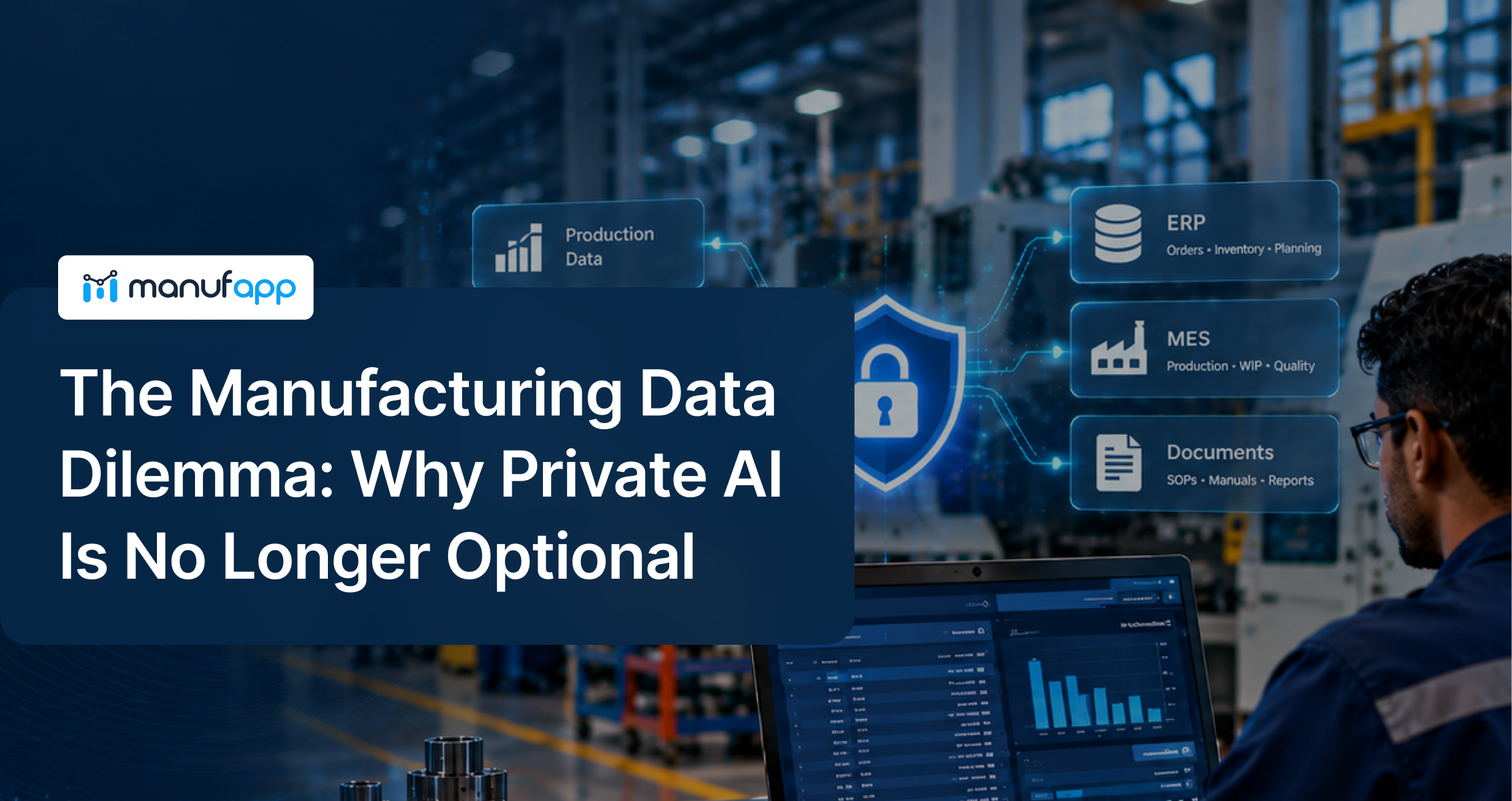
- Secure Integration: ERP, MES, and document systems connect through approved interfaces.
- Auditability: Important AI interactions and data access events can be recorded.
- Operational Accountability: Human approval remains in place for critical manufacturing decisions.
For example, a maintenance engineer could ask an internal AI assistant to identify recurring failures for a particular machine.
The assistant could retrieve authorised maintenance records, summarise past incidents, and reference relevant troubleshooting documents.
The engineer receives useful information without unnecessarily exposing unrelated customer, finance, or commercial records.
Private AI vs Public AI: Key Differences for Manufacturers
Many manufacturers already use publicly accessible AI tools for drafting documents, summarising information, and answering general questions.
These tools can be valuable when used appropriately.
However, analysing confidential production records or proprietary engineering information introduces additional security requirements.
The distinction is not that public AI is always unsafe or private AI is automatically secure. The difference lies in the controls, contractual protections, deployment architecture, and organisational governance.
| Key Factor | General-Purpose Public AI | Controlled Private AI |
| Data Processing | Usually processed through provider-managed infrastructure | Processing environment selected according to business requirements |
| Data Access | Often depends on information users manually provide | Can integrate with authorised internal manufacturing records |
| Access Control | Depends on the application and subscription | Can enforce factory-specific roles and permissions |
| Data Retention | Governed by provider terms and configuration | Can follow organisation-defined retention policies |
| ERP/MES Integration | May require additional tools or integrations | Can be designed around approved manufacturing workflows |
| Customisation | Typically general-purpose | Can be tailored to manufacturing terminology and operational needs |
| Governance | Depends on available enterprise features | Can support organisation-specific controls and auditing |
The key takeaway: Manufacturers do not necessarily need a completely isolated AI model for every task. They need an AI approach that matches the sensitivity of their data and the importance of the decisions being supported.
Practical Use Cases of Private AI in Manufacturing
The strongest opportunities for private AI are often found in everyday manufacturing activities.
Many factories already have the information required to solve operational problems. The difficulty lies in finding and interpreting it quickly.
1. Turning Manufacturing Experience into Accessible Knowledge
Factories depend heavily on experienced production supervisors, maintenance engineers, and quality specialists.
These employees understand machine behaviour, unusual production conditions, recurring defects, and practical troubleshooting methods.
However, valuable knowledge is frequently spread across SOPs, maintenance reports, inspection documents, and individual experience.
A private AI assistant connected to approved knowledge sources can make this information easier to retrieve.
For example, a technician could ask:
What corrective actions were taken during the previous breakdowns of this machine?
Instead of manually reviewing historical tickets, the technician could receive a summary supported by relevant records.
This connects directly to the challenge of eliminating tribal knowledge with private AI.
2. Improving Production Planning and Shopfloor Visibility
Production planning depends on accurate information about orders, inventory, machine capacity, and work-in-progress.
When these records are maintained in separate spreadsheets or disconnected systems, identifying operational problems can take considerable effort.
An AI assistant connected to authorised manufacturing information could help answer questions such as:
- Which production orders are falling behind schedule?
- Which work centres have accumulated excessive WIP?
- Which material shortages could affect upcoming production?
- Where is actual output consistently below planned production?
The purpose is not to replace planning software.
Instead, AI can help users understand the information already captured by ERP and MES systems.
3. Supporting Quality Investigations and Traceability
Consider a manufacturer receiving a customer complaint about a defective component.
The quality team may need to identify the relevant production batch, raw material lot, machine, inspection results, and dispatch records.
If this information is available in a connected manufacturing system, an authorised AI assistant can help organise the records and identify patterns worth investigating.
However, AI cannot reliably reconstruct production history that was never recorded.
A structured manufacturing traceability system remains essential for maintaining the relationships between materials, processes, inspections, and finished goods.
4. Making Maintenance Information Easier to Use
Maintenance teams often accumulate years of breakdown records, preventive maintenance documents, equipment manuals, and technician observations.
Finding relevant information during a machine failure can be difficult.
Private AI can assist by searching approved maintenance documentation and summarising historical incidents.
For example, a maintenance engineer could investigate whether repeated breakdowns occurred after particular servicing activities.
The AI response may help narrow the investigation, while the engineer remains responsible for verifying the findings.
These opportunities are closely connected to the applications discussed in AI in maintenance management.
How Private AI Works with Manufacturing ERP and MES
AI cannot consistently provide useful factory-specific insights without reliable operational information.
This is where manufacturing ERP and MES systems become important.
ERP systems maintain business information related to purchasing, sales orders, inventory, procurement, and planning.
MES systems capture shopfloor information such as production execution, WIP movement, inspection results, and machine-related events.
When this information is structured and maintained accurately, it becomes more useful for AI-assisted analysis.
An AI application can use controlled retrieval methods to access relevant authorised records and generate responses based on available information.
How a Controlled Manufacturing AI Workflow Can Operate
Factory User → Access Verification → Private AI Application → Authorised ERP/MES Data → AI Response with Source References
Each stage serves a purpose.
First, the system verifies the user’s identity and permissions.
Next, the AI application identifies the records relevant to the question.
Finally, it presents an answer that users can review against the underlying information.
This approach can be implemented using methods such as retrieval-augmented generation (RAG), where AI retrieves relevant information before producing a response.
The AI application should also distinguish between accessing information and changing operational records.
For example, asking for yesterday’s production summary is different from approving a quality inspection or modifying inventory quantities.
Actions that alter manufacturing records require separate controls, validation, and authorisation.
Platforms such as ManufApp provide structured manufacturing workflows that can form part of the data foundation for evaluating controlled AI applications.
For more information about how business and production systems work together, explore ERP architecture and manufacturing modules.
Key Security Features to Look for in Private AI
Private AI adoption should begin with a clear understanding of business requirements rather than choosing a model based only on its capabilities.
The following considerations can help manufacturers evaluate potential solutions.
| Evaluation Area | Key Question | Why It Matters |
| Data Security | Where is our information processed and stored? | Helps identify privacy, confidentiality, and compliance concerns |
| Data Ownership & Usage | Can our records be used for model training or other purposes? | Protects sensitive manufacturing information |
| User Permissions | Will AI respect existing departmental access restrictions? | Prevents unauthorised information exposure |
| System Integration | Can AI securely access our ERP, MES, and approved documents? | Enables relevant, context-based insights |
| Response Reliability | Can users verify answers against source records? | Reduces the risk of decisions based on incorrect information |
| Operational Control | Who approves actions affecting production, quality, or inventory? | Preserves accountability for critical processes |
Manufacturers should also consider how the system handles incomplete information, outdated records, and questions outside its authorised scope.
A secure AI implementation must be designed to acknowledge uncertainty rather than present unsupported assumptions as facts.
How to Implement Private AI in Manufacturing
Implementing private AI does not require connecting every factory system on the first day.
A focused approach can help manufacturers understand the value and limitations before expanding the application.
Start with a Specific Manufacturing Problem
Choose a practical use case, such as searching maintenance records, summarising approved production reports, or retrieving SOP information.
Avoid beginning with an overly broad objective of making the entire factory AI-driven.
Identify and Classify the Required Data
Determine which systems and documents contain the information needed for the selected use case.
Separate public, internal, confidential, and highly sensitive records according to organisational requirements.
Establish Permissions and Security Controls
Define who can access the AI application and which data sources each user can retrieve.
Review hosting arrangements, retention policies, access logs, and provider commitments.
Evaluate Results Before Expanding
Test the assistant using realistic factory questions.
Check whether its answers are accurate, relevant, and supported by the underlying data.
Pay particular attention to cases involving missing records, conflicting information, or restricted access.
Build on Reliable Operational Data
Factories should also examine the quality of their existing information.
If breakdown tickets are incomplete, inventory transactions are delayed, or production records are inconsistent, AI may struggle to produce meaningful insights.
Better data collection and structured operational processes are essential foundations.
Manufacturers should improve data reliability and AI governance together, rather than expecting AI to correct every weakness in existing systems.
Building a Secure Future for Manufacturing AI
Artificial intelligence is creating opportunities for manufacturers to access information faster, analyse operational patterns, and support employees with better decision-making tools.
From production analysis to maintenance knowledge retrieval, the number of potential AI applications in manufacturing continues to grow.
However, more capable AI does not remove the responsibility to protect sensitive manufacturing information.
For factories, trust must extend beyond whether an AI system can produce a useful answer.
It must include confidence that operational records remain protected, users receive only authorised information, and important decisions remain accountable.
This is why private AI in manufacturing is becoming a strategic consideration.
Not every factory requires an on-premises AI model, and not every AI task involves confidential information.
But as artificial intelligence becomes more closely connected to production systems, quality records, customer specifications, and manufacturing knowledge, strong data governance becomes essential.
The manufacturers best prepared to benefit from AI will be those that combine reliable operational information with appropriate security, access controls, and responsible implementation.
Frequently Asked Questions
1. What is private AI in manufacturing?
Private AI in manufacturing refers to artificial intelligence implemented with defined controls over how factory information is accessed, processed, stored, and used. It can support activities such as knowledge retrieval, operational analysis, and decision support while protecting sensitive business data.
2. Is private AI more secure than public AI?
Private AI can offer greater organisational control, but security depends on the implementation. Public AI providers may also offer enterprise-grade safeguards. Manufacturers should evaluate data handling terms, access permissions, retention policies, and security architecture rather than relying only on labels.
3. Can private AI integrate with manufacturing ERP and MES systems?
Yes, where suitable integrations are supported. Private AI applications can retrieve authorised information from ERP, MES, maintenance, quality, and document systems to support factory-specific analysis.
4. Does private AI require an on-premises server?
No. Private AI may use dedicated cloud environments, on-premises infrastructure, enterprise-managed AI services, or hybrid deployments, depending on business and security requirements.
5. Can private AI replace manufacturing ERP software?
No. ERP and MES systems remain responsible for structured business transactions and shopfloor records. AI can complement these systems by making information easier to retrieve, analyse, and interpret.